







Question: In a multiple linear regression analysis, (yu, Xi , Xz), i = 1, ..., n, are statistically independent and satisfy the model (M1) given by:
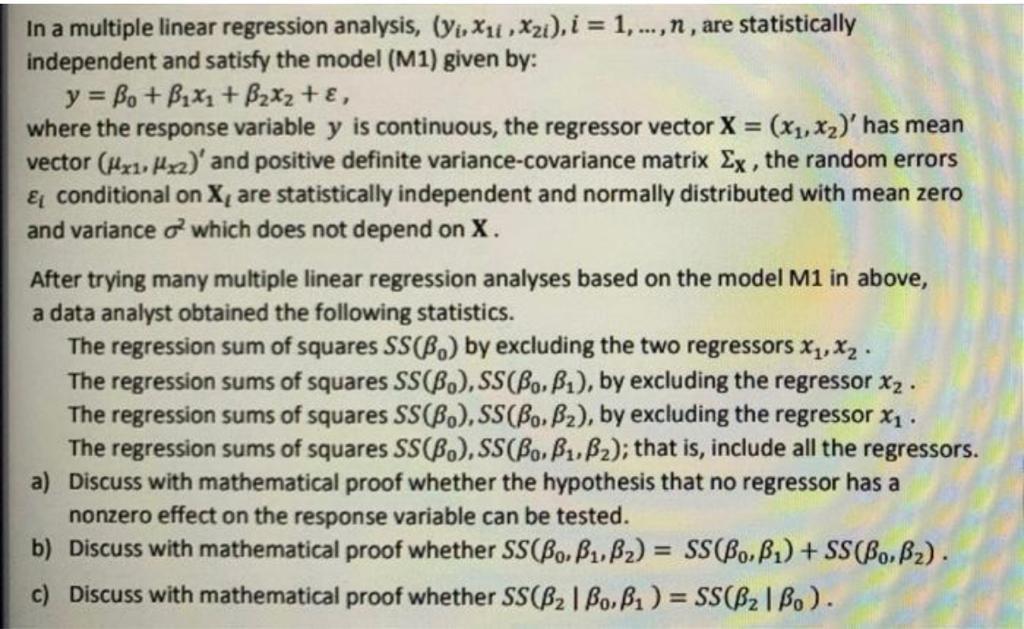
In a multiple linear regression analysis, (yu, Xi , Xz), i = 1, ..., n, are statistically independent and satisfy the model (M1) given by: y = Bot Bix + B2x2 + E, where the response variable y is continuous, the regressor vector X = (X1, X2)' has mean vector (Hx1, Hx2)' and positive definite variance-covariance matrix Ex , the random errors & conditional on X, are statistically independent and normally distributed with mean zero and variance of which does not depend on X . After trying many multiple linear regression analyses based on the model M1 in above, a data analyst obtained the following statistics. The regression sum of squares SS(Bo) by excluding the two regressors x1, X2 . The regression sums of squares SS(Bo), SS(Bo, B1), by excluding the regressor X2 . The regression sums of squares SS(Bo), SS(Bo. B2), by excluding the regressor x] . The regression sums of squares SS(Bo), SS(Bo. B1, B2); that is, include all the regressors. a) Discuss with mathematical proof whether the hypothesis that no regressor has a nonzero effect on the response variable can be tested. b) Discuss with mathematical proof whether SS(Bo, B1, B2) = SS(Bo, Bi) + SS(Bo, Bz) . c) Discuss with mathematical proof whether SS(B2 | Bo, B1 ) = SS(Bz | Bo )
Step by Step Solution
There are 3 Steps involved in it

Get step-by-step solutions from verified subject matter experts
 Study Help