







Question: In a process cost system, ending inventory is valued Finding the sum of all open job costs Multiplying units in ending inventory by the direct
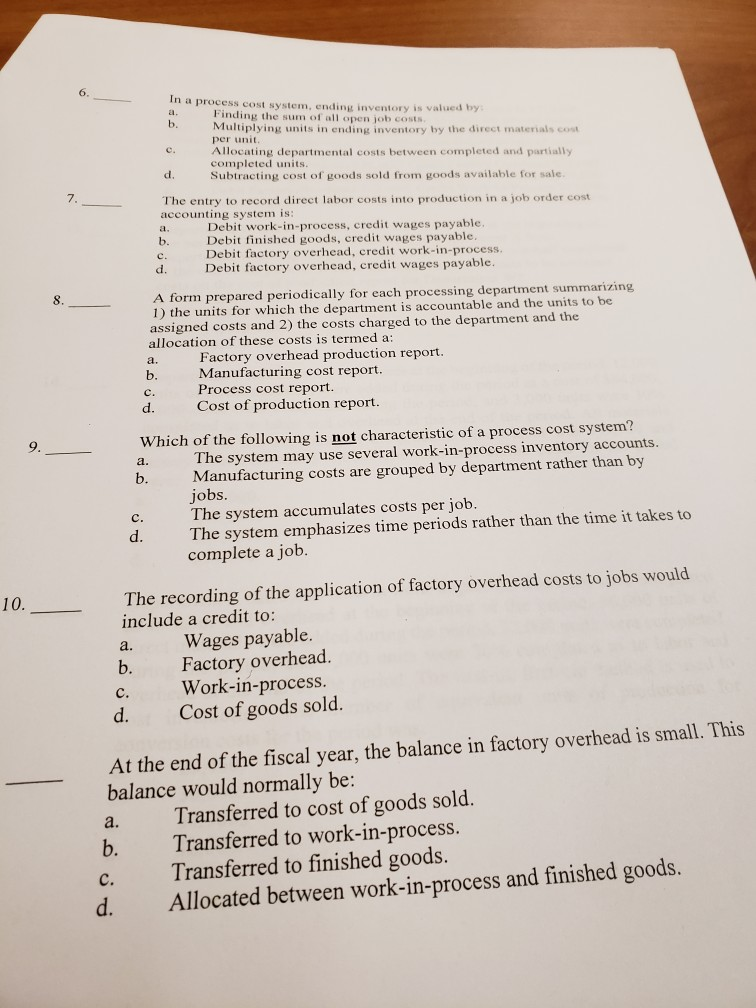
In a process cost system, ending inventory is valued Finding the sum of all open job costs Multiplying units in ending inventory by the direct materials co per unit. Allocating departmental costs between completed and partially completed units. Subtracting cost of goods sold from goods available for sale d. The entry to record direct labor costs into production in a job order cost accounting system is Debit work-in-process, credit wages payable. Debit finished goods, credit wages payable. Debit factory overhead, credit work-in-process Debit factory overhead, credit wages payable b. 8. A form prepared periodically for each processing department summarizing 1) the units for which the department is accountable and the units to be assigned costs and 2) the costs charged to the department and the allocation of these costs is termed a: Factory overhead production report. Manufacturing cost report. Process cost report. Cost of production report. b. c. d. 9.Which of the following is not characteristic of a process cost system? The system may use several work-in-process inventory accounts Manufacturing costs are grouped by department rather than by jobs The system accumulates costs per job. The system emphasizes time periods rather than the time it takes to complete a job, b. c. d. The recording of the application of factory overhead costs to jobs would include a credit to: a. Wages payable. b. Factory overhead. c. Work-in-process. d. Cost of goods sold. 10. At the end of the fiscal year, the balance in factory overhead is small. This balance would normally be: a. Transferred to cost of goods sold. b. Transferred to work-in-process. c. Transferred to finished goods. Allocated between work-in-process and finished goods
Step by Step Solution
There are 3 Steps involved in it

Get step-by-step solutions from verified subject matter experts
 Study Help