







Question: In a queueing system for telephone calls, suppose that there is one queue with s servers. The interarrival times of calls are distributed following the
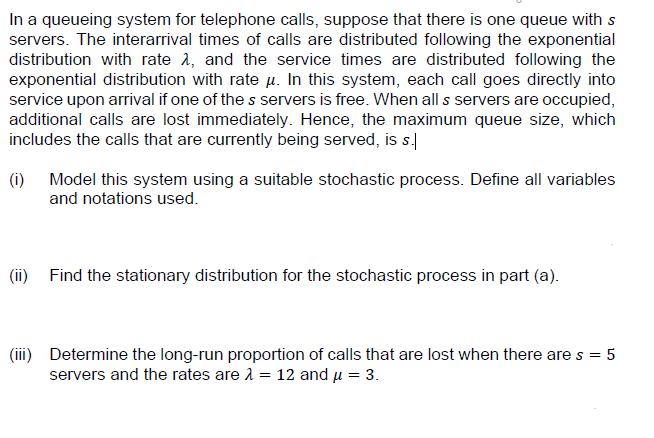
In a queueing system for telephone calls, suppose that there is one queue with s servers. The interarrival times of calls are distributed following the exponential distribution with rate 1, and the service times are distributed following the exponential distribution with rate u. In this system, each call goes directly into service upon arrival if one of the s servers is free. When alls servers are occupied, additional calls are lost immediately. Hence, the maximum queue size, which includes the calls that are currently being served, is s. (1) Model this system using a suitable stochastic process. Define all variables and notations used. (ii) Find the stationary distribution for the stochastic process in part (a). (iii) Determine the long-run proportion of calls that are lost when there are s = 5 servers and the rates are 1 = 12 and u = 3. In a queueing system for telephone calls, suppose that there is one queue with s servers. The interarrival times of calls are distributed following the exponential distribution with rate 1, and the service times are distributed following the exponential distribution with rate u. In this system, each call goes directly into service upon arrival if one of the s servers is free. When alls servers are occupied, additional calls are lost immediately. Hence, the maximum queue size, which includes the calls that are currently being served, is s. (1) Model this system using a suitable stochastic process. Define all variables and notations used. (ii) Find the stationary distribution for the stochastic process in part (a). (iii) Determine the long-run proportion of calls that are lost when there are s = 5 servers and the rates are 1 = 12 and u = 3
Step by Step Solution
There are 3 Steps involved in it

Get step-by-step solutions from verified subject matter experts
 Study Help