







Question: In a recent lecture, I asked a question shown in Figure 1, and after some discussion, I indicated that the rst answer choice was the
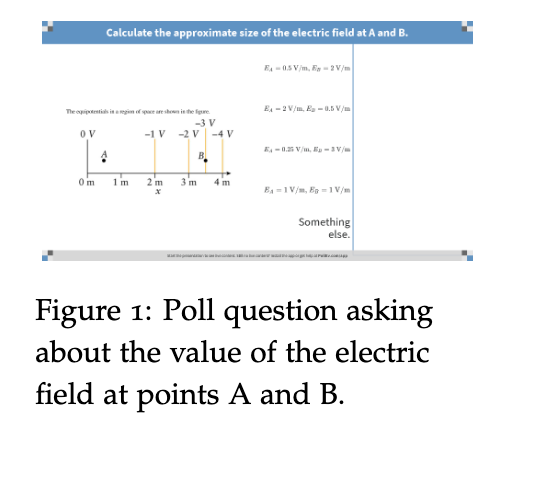
In a recent lecture, I asked a question shown in Figure 1, and after some discussion, I indicated that the rst answer choice was the answer. I've since had a discussion with several students who have argued compellingly that this isn't a good answer. In what follows, I para- phrase one of their communications with me: \"We don't agree that the electric field in between two different meter marks is uniform enough to make the approximation that you made in class. We know that there is a negative charge on the right-hand side, and as we ap- proach this charge the equipotentials get closer and closer together and the volt values become larger in magnitude as we approach the charge (using the electric potential curve). \"Between the 2 m and 4 m marks, there must be some point where the electric eld is 2 V / m. However, there isn't enough information to say the size at point B; this becomes more problematic for point A where the approximation is over an even larger space. We see two major issues: 1. The average value of the electric eld would be the same at any point between the two meter marks you chose. So you'd conclude the size of the electric eld is equal at 0.5 m and 1.5 m, and also the same at 3.5 m and 3.25 m; and 2. The schematic shows the electric potential changes non-linearly. Therefore, using a linear approximation leads down the wrong path (especially if that approximation involves just 2 lines in a stepwise function that's not innitely differentiablel). \"Because of this, in our opinion, the model is oversimplied.\" How do you respond to these students' argument? Do you agree, disagree? What questions come up for you? Calculate the approximate size of the electric field at A and B. FA = 05V/m. Ex - 2V/m The spiportion is a spin of quiet an dom is he ipre. Ex - !V/m. 2 - 0.6V/ -3V -IV IV -4V 0 m 1 m 2 m 3 m 4 m By = 1V/m, Bo = IV/m Something else. Figure 1: Poll question asking about the value of the electric field at points A and B
Step by Step Solution
There are 3 Steps involved in it

Get step-by-step solutions from verified subject matter experts
 Study Help