







Question: In a simple language, there are only three letters: A, B and C. Any combination of A's, B's and C's forms a word, with
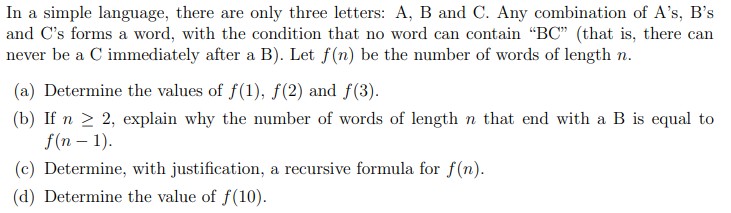
In a simple language, there are only three letters: A, B and C. Any combination of A's, B's and C's forms a word, with the condition that no word can contain "BC" (that is, there can never be a C immediately after a B). Let f(n) be the number of words of length n. (a) Determine the values of f(1), f(2) and f(3). (b) If n 2, explain why the number of words of length n that end with a B is equal to f(n-1). (c) Determine, with justification, a recursive formula for f(n). (d) Determine the value of f(10).
Step by Step Solution
3.43 Rating (156 Votes )
There are 3 Steps involved in it
Lets solve the problem stepbystep a Determine the values of f1 f2 and f3 f1 For words of length 1 the possible letters are A B and C So f1 3 f2 For wo... View full answer

Get step-by-step solutions from verified subject matter experts
 Study Help