







Question: In a video we derived an expression for how the enthalpy changed with pressure at constant temperature. We also showed how, if you utilize the
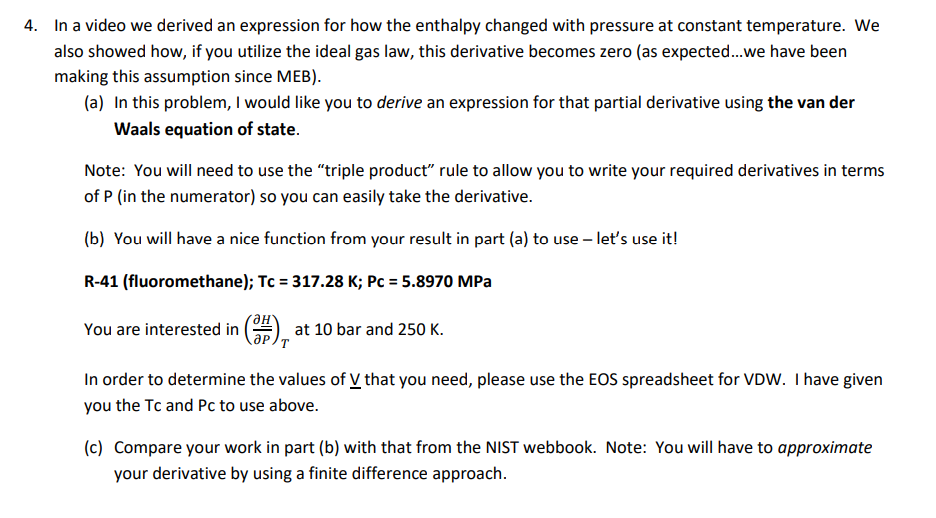
In a video we derived an expression for how the enthalpy changed with pressure at constant temperature. We also showed how, if you utilize the ideal gas law, this derivative becomes zero (as expected...we have been making this assumption since MEB). (a) In this problem, I would like you to derive an expression for that partial derivative using the van der Waals equation of state. Note: You will need to use the "triple product" rule to allow you to write your required derivatives in terms of P (in the numerator) so you can easily take the derivative. (b) You will have a nice function from your result in part (a) to use - let's use it! R41 (fluoromethane); TC=317.28K;Pc=5.8970MPa You are interested in (PH)T at 10 bar and 250K. In order to determine the values of V that you need, please use the EOS spreadsheet for VDW. I have given you the Tc and Pc to use above. (c) Compare your work in part (b) with that from the NIST webbook. Note: You will have to approximate your derivative by using a finite difference approach. In a video we derived an expression for how the enthalpy changed with pressure at constant temperature. We also showed how, if you utilize the ideal gas law, this derivative becomes zero (as expected...we have been making this assumption since MEB). (a) In this problem, I would like you to derive an expression for that partial derivative using the van der Waals equation of state. Note: You will need to use the "triple product" rule to allow you to write your required derivatives in terms of P (in the numerator) so you can easily take the derivative. (b) You will have a nice function from your result in part (a) to use - let's use it! R41 (fluoromethane); TC=317.28K;Pc=5.8970MPa You are interested in (PH)T at 10 bar and 250K. In order to determine the values of V that you need, please use the EOS spreadsheet for VDW. I have given you the Tc and Pc to use above. (c) Compare your work in part (b) with that from the NIST webbook. Note: You will have to approximate your derivative by using a finite difference approach
Step by Step Solution
There are 3 Steps involved in it

Get step-by-step solutions from verified subject matter experts
 Study Help