Question: In an experiment to learn if substance M can help restore memory, the brains of 20 rats were treated to damage their memories. The rats
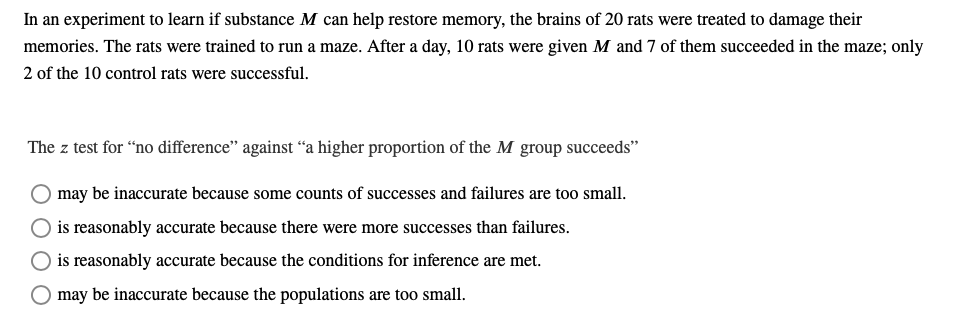
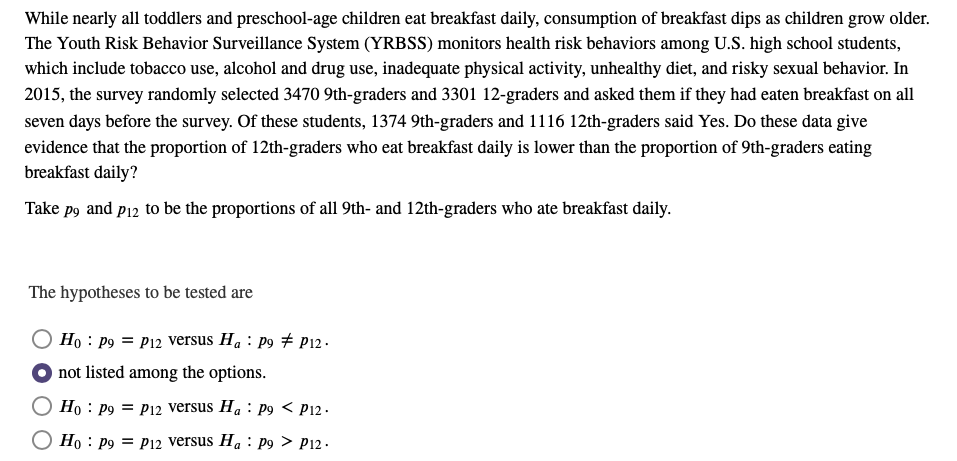
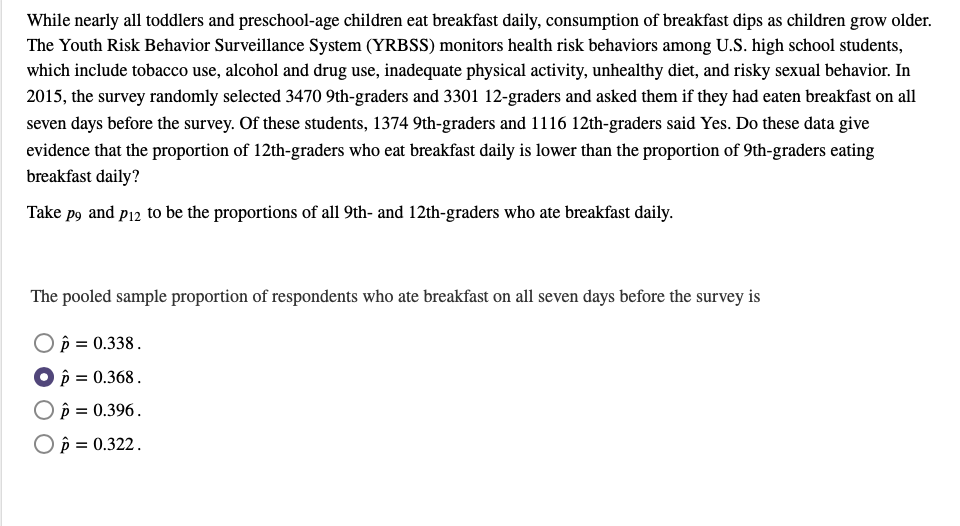
In an experiment to learn if substance M can help restore memory, the brains of 20 rats were treated to damage their memories. The rats were trained to run a maze. After a day, 10 rats were given M and 7 of them succeeded in the maze; only 2 of the 10 control rats were successful. The z test for no difference" against a higher proportion of the M group succeeds may be inaccurate because some counts of successes and failures are too small. is reasonably accurate because there were more successes than failures. is reasonably accurate because the conditions for inference are met. may be inaccurate because the populations are too small. While nearly all toddlers and preschool-age children eat breakfast daily, consumption of breakfast dips as children grow older. The Youth Risk Behavior Surveillance System (YRBSS) monitors health risk behaviors among U.S. high school students, which include tobacco use, alcohol and drug use, inadequate physical activity, unhealthy diet, and risky sexual behavior. In 2015, the survey randomly selected 3470 9th-graders and 3301 12-graders and asked them if they had eaten breakfast on all seven days before the survey. Of these students, 1374 9th-graders and 1116 12th-graders said Yes. Do these data give evidence that the proportion of 12th-graders who eat breakfast daily is lower than the proportion of 9th-graders eating breakfast daily? Take p, and P12 to be the proportions of all 9th- and 12th-graders who ate breakfast daily. The hypotheses to be tested are Ho : pg = P12 versus Hq : P9 P12. not listed among the options. H: P9 = P12 versus Hq : pg P12. While nearly all toddlers and preschool-age children eat breakfast daily, consumption of breakfast dips as children grow older. The Youth Risk Behavior Surveillance System (YRBSS) monitors health risk behaviors among U.S. high school students, which include tobacco use, alcohol and drug use, inadequate physical activity, unhealthy diet, and risky sexual behavior. In 2015, the survey randomly selected 3470 9th-graders and 3301 12-graders and asked them if they had eaten breakfast on all seven days before the survey. Of these students, 1374 9th-graders and 1116 12th-graders said Yes. Do these data give evidence that the proportion of 12th-graders who eat breakfast daily is lower than the proportion of 9th-graders eating breakfast daily? Take pg and P12 to be the proportions of all 9th- and 12th-graders who ate breakfast daily. The pooled sample proportion of respondents who ate breakfast on all seven days before the survey is O f = 0.338. O p = 0.368 O f = 0.396. O f = 0.322




