



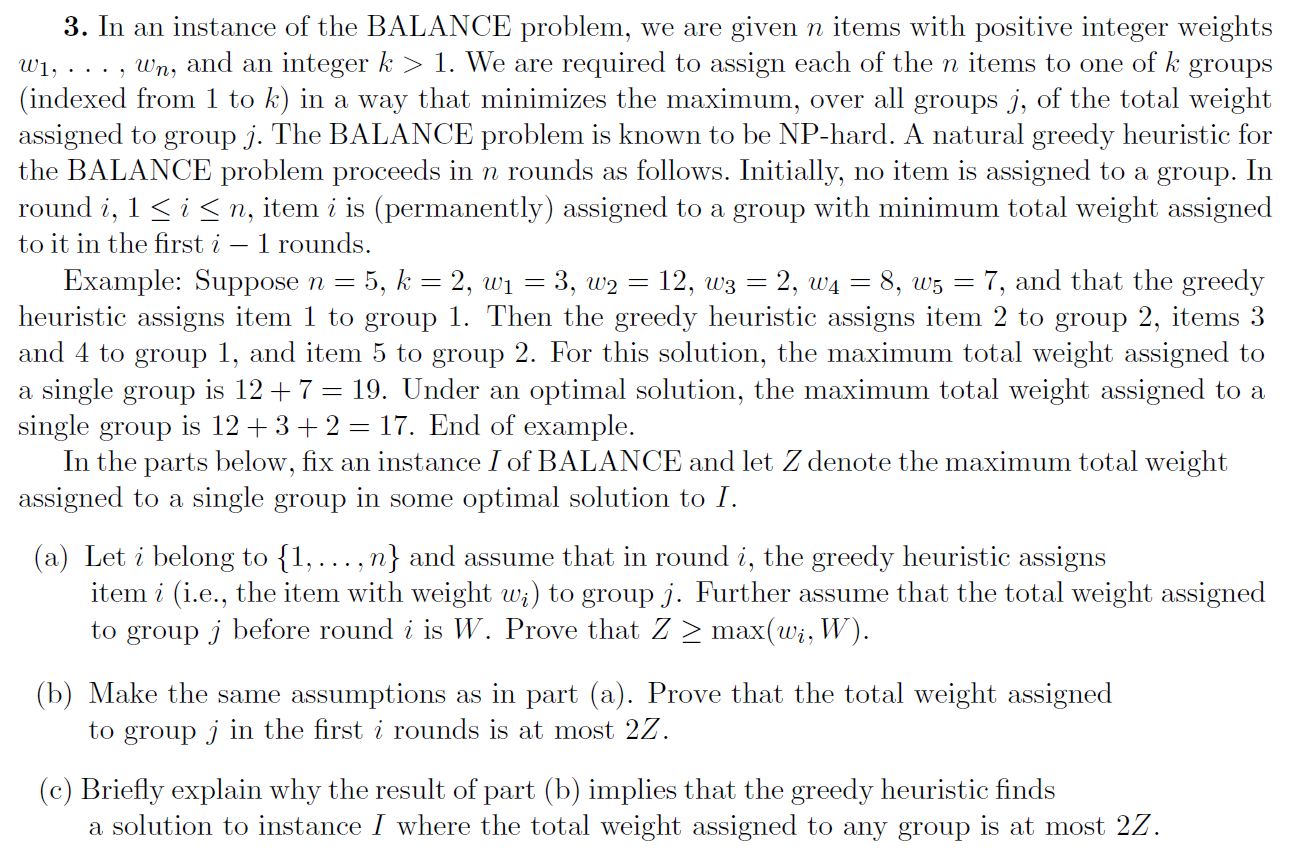
Question: In an instance of the BALANCE problem, we are given n items with positive integer weights w 1 , dots, w n , and an
In an instance of the BALANCE problem, we are given items with positive integer weights
dots, and an integer We are required to assign each of the items to one of groups
indexed from to in a way that minimizes the maximum, over all groups of the total weight
assigned to group The BALANCE problem is known to be NPhard. A natural greedy heuristic for
the BALANCE problem proceeds in rounds as follows. Initially, no item is assigned to a group. In
round item is permanently assigned to a group with minimum total weight assigned
to it in the first rounds.
Example: Suppose and that the greedy
heuristic assigns item to group Then the greedy heuristic assigns item to group items
and to group and item to group For this solution, the maximum total weight assigned to
a single group is Under an optimal solution, the maximum total weight assigned to a
single group is End of example.
In the parts below, fix an instance I of BALANCE and let denote the maximum total weight
assigned to a single group in some optimal solution to I.
a Let i belong to dots, and assume that in round the greedy heuristic assigns
item ie the item with weight to group Further assume that the total weight assigned
to group before round is Prove that max
b Make the same assumptions as in part a Prove that the total weight assigned
to group in the first i rounds is at most
c Briefly explain why the result of part b implies that the greedy heuristic finds
a solution to instance I where the total weight assigned to any group is at most
Step by Step Solution
There are 3 Steps involved in it
1 Expert Approved Answer
Step: 1 Unlock

Question Has Been Solved by an Expert!
Get step-by-step solutions from verified subject matter experts
Step: 2 Unlock
Step: 3 Unlock