Question: In Assignment 3 problem 4 (Solberg 2.11), we formulated a Markov chain that describes the debt pay- ment. Referring to the same problem, answer the
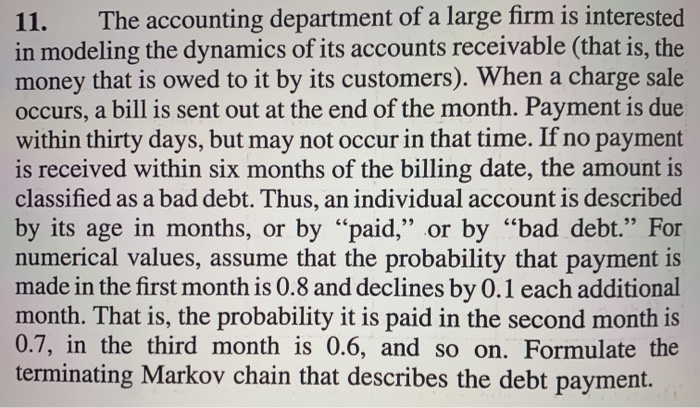
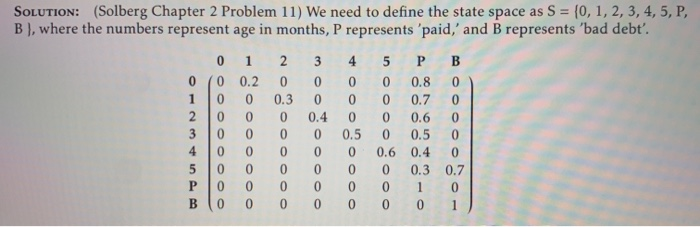
In Assignment 3 problem 4 (Solberg 2.11), we formulated a Markov chain that describes the debt pay- ment. Referring to the same problem, answer the following questions: a. What is the probability that a new sale will ultimately be paid for? b. What is the probability that a bill that is not paid within the thirty-day period will never be paid? c. What is the probability that a bill will reach the point where it has gone three months without being paid? 11. The accounting department of a large firm is interested in modeling the dynamics of its accounts receivable (that is, the money that is owed to it by its customers). When a charge sale occurs, a bill is sent out at the end of the month. Payment is due within thirty days, but may not occur in that time. If no payment is received within six months of the billing date, the amount is classified as a bad debt. Thus, an individual account is described by its age in months, or by paid, or by bad debt. For numerical values, assume that the probability that payment is made in the first month is 0.8 and declines by 0.1 each additional month. That is, the probability it is paid in the second month is 0.7, in the third month is 0.6, and so on. Formulate the terminating Markov chain that describes the debt payment. SOLUTION: (Solberg Chapter 2 Problem 11) We need to define the state space as S = {0, 1, 2, 3, 4, 5, P, B), where the numbers represent age in months, P represents 'paid,' and B represents 'bad debt'. 0 1 0 1 3 4 5 B 0 0.2 0 0 0 0 0 0 0 0 0 0 0 0 0 2 0 0.3 0 0 0 0 0 0 3 0 0 0.4 0 0 0 0 0 4 0 0 0 0.5 0 0 0 0 5 P B 0 0.8 0 0 0.7 0 0 0.6 0 0 0.5 0 0.6 0.4 0 0 0.3 0.7 0 1 0 0 0 1 In Assignment 3 problem 4 (Solberg 2.11), we formulated a Markov chain that describes the debt pay- ment. Referring to the same problem, answer the following questions: a. What is the probability that a new sale will ultimately be paid for? b. What is the probability that a bill that is not paid within the thirty-day period will never be paid? c. What is the probability that a bill will reach the point where it has gone three months without being paid? 11. The accounting department of a large firm is interested in modeling the dynamics of its accounts receivable (that is, the money that is owed to it by its customers). When a charge sale occurs, a bill is sent out at the end of the month. Payment is due within thirty days, but may not occur in that time. If no payment is received within six months of the billing date, the amount is classified as a bad debt. Thus, an individual account is described by its age in months, or by paid, or by bad debt. For numerical values, assume that the probability that payment is made in the first month is 0.8 and declines by 0.1 each additional month. That is, the probability it is paid in the second month is 0.7, in the third month is 0.6, and so on. Formulate the terminating Markov chain that describes the debt payment. SOLUTION: (Solberg Chapter 2 Problem 11) We need to define the state space as S = {0, 1, 2, 3, 4, 5, P, B), where the numbers represent age in months, P represents 'paid,' and B represents 'bad debt'. 0 1 0 1 3 4 5 B 0 0.2 0 0 0 0 0 0 0 0 0 0 0 0 0 2 0 0.3 0 0 0 0 0 0 3 0 0 0.4 0 0 0 0 0 4 0 0 0 0.5 0 0 0 0 5 P B 0 0.8 0 0 0.7 0 0 0.6 0 0 0.5 0 0.6 0.4 0 0 0.3 0.7 0 1 0 0 0 1










 Study Help