







Question: in c++ 1-When a function begins execution: (might have more than 1 correct answer) a) space is allocated for its parameter and local variables b)
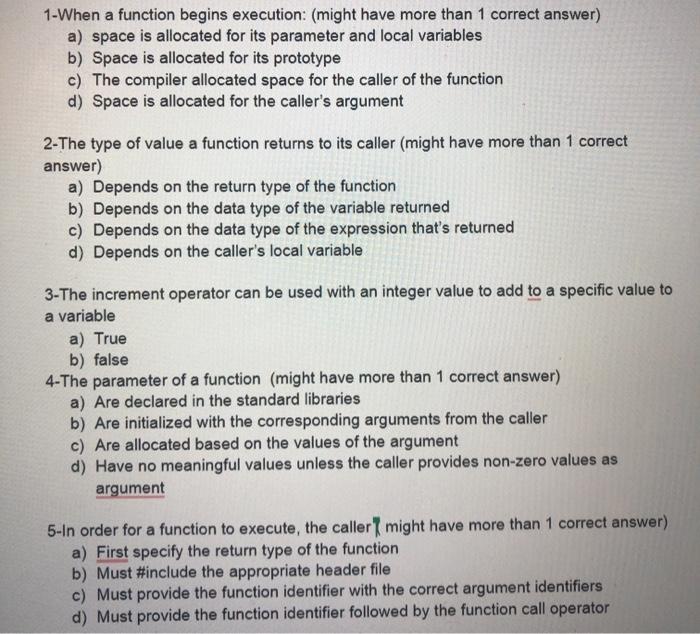
1-When a function begins execution: (might have more than 1 correct answer) a) space is allocated for its parameter and local variables b) Space is allocated for its prototype c) The compiler allocated space for the caller of the function d) Space is allocated for the caller's argument 2-The type of value a function returns to its caller (might have more than 1 correct answer) a) Depends on the return type of the function b) Depends on the data type of the variable returned c) Depends on the data type of the expression that's returned d) Depends on the caller's local variable 3-The increment operator can be used with an integer value to add to a specific value to a variable a) True b) false 4-The parameter of a function (might have more than 1 correct answer) a) Are declared in the standard libraries b) Are initialized with the corresponding arguments from the caller c) Are allocated based on the values of the argument d) Have no meaningful values unless the caller provides non-zero values as argument 5-In order for a function to execute, the callerI might have more than 1 correct answer) a) First specify the return type of the function b) Must #include the appropriate header file c) Must provide the function identifier with the correct argument identifiers d) Must provide the function identifier followed by the function call operator
Step by Step Solution
There are 3 Steps involved in it

Get step-by-step solutions from verified subject matter experts
 Study Help