Question: In C++ a= In C++ In base -2, integers are represented by sequences of bits in the following way. Bits are ordered from the least

In C++
 In C++ a= In C++ In base -2, integers are representedby sequences of bits in the following way. Bits are ordered froma=

In C++

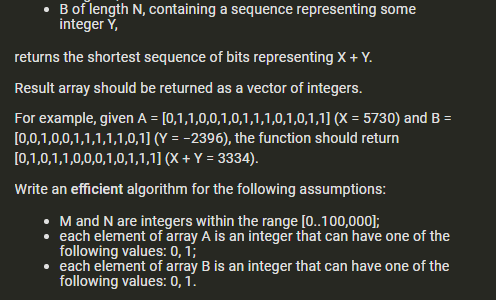
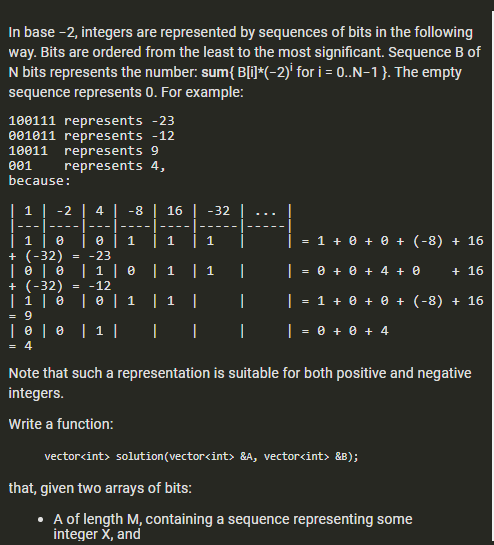
In base -2, integers are represented by sequences of bits in the following way. Bits are ordered from the least to the most significant. Sequence B of N bits represents the number: sum{ B[i]*(-2)' for i = 0...N-1}. The empty sequence represents 0. For example: 100111 represents -23 001011 represents -12 10011 represents 9 represents 4, because: 001 1 | -2 4 -8 16 -32 --- -- 1 1 = 1 + 0 + 0 + (-8) + 16 = -23 | 1 0 + 0 + 4 + + 16 1 | 0 0 | 1 1 + (-32) 100 | 10 | 1 + (-32) = -12 | 10 | 0 | 1 | 1 = 9 100 | 1 | = 4 1 + | = 1 + 0 + 0 + (-8) + 16 | = 0 + 0 + 4 Note that such a representation is suitable for both positive and negative integers. Write a function: vector &A, vector int> &B); that, given two arrays of bits: A of length M, containing a sequence representing some integer X, and B of length N, containing a sequence representing some integer Y, returns the shortest sequence of bits representing X + Y. Result array should be returned as a vector of integers. For example, given A = [0,1,1,0,0,1,0,1,1,1,0,1,0,1,1) (X = 5730) and B = [0,0,1,0,0,1,1,1,1,1,0,1) (Y = -2396), the function should return [0,1,0,1,1,0,0,0,1,0,1,1,1) (X + Y = 3334). Write an efficient algorithm for the following assumptions: Mand N are integers within the range [0..100,000); each element of array A is an integer that can have one of the following values: 0,1; each element of array B is an integer that can have one of the following values: 0,1

Step by Step Solution

There are 3 Steps involved in it

1 Expert Approved Answer
Step: 1 Unlock blur-text-image
Question Has Been Solved by an Expert!

Get step-by-step solutions from verified subject matter experts

Step: 2 Unlock
Step: 3 Unlock

Students Have Also Explored These Related Databases Questions!