







Question: In C++ Create a derived class named turbine_dev based on the turbine class in the attached turbine.cpp code which is located below. The objective is
In C++
Create a derived class named turbine_dev based on the turbine class in the attached turbine.cpp code which is located below. The objective is for reading parameters from an input text file and writing the computed power to an output text file. To give you an idea, example text files are shown directly below.
param0.txt
rotor-radius(m) = 50 location(m) = 0 induction factor = 0.1
param1.txt
rotor-radius(m) = 50 location(m) = 800 induction factor = 0.2
param2.txt
rotor-radius(m) = 50 location(m) = 1800 induction factor = 0.3
power0.txt
turbine-location = 0 induction factor = 0.1 power (MW) = 1.55862
power1.txt
turbine-location = 800 induction factor = 0.2 power (MW) = 2.2508
power2.txt
turbine-location = 1800 induction factor = 0.3 power (MW) = 2.25534
Basically I need help editing the code below so that it takes in input text files such as the ones shown above (eg. param0.txt, param1.txt) and outputes the turbine power in an output text file (eg. power0.txt, power1.txt).
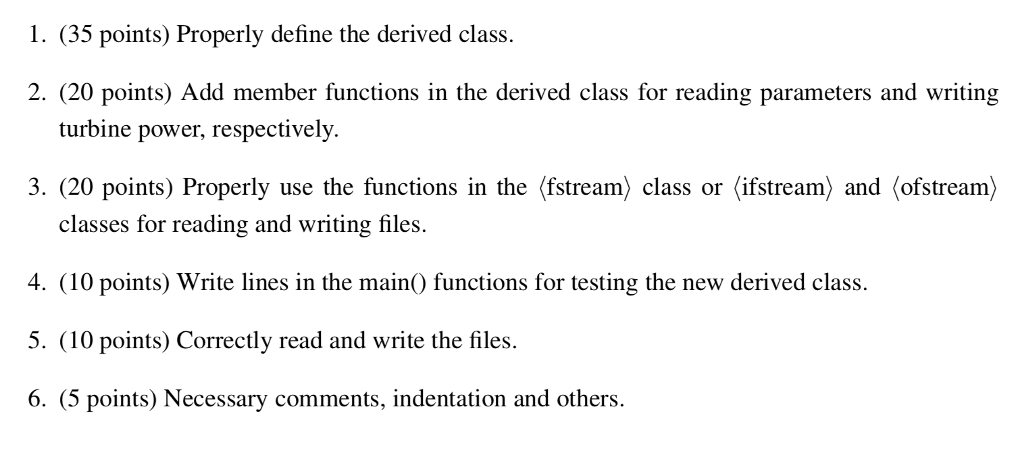
The specifications for the code are as follows:
The Turbine.cpp Code:
/* create a derived class turbine_dev adding capability for computing incoming turbulence intensity of each turbine */
#include
#include
using namespace std;
const double PI = acos(-1.0);
const double rho = 1.225;
double windspeed_freeincoming;
class turbine // define a turbine class
{
private:
double turbinecoor; // location of the turbine
double radius_rotor; // rotor radius
double inductionfactor_axis; // axial induction factor
double coeff_power; // power coefficient
double windspeed_incoming; // incoming wind speed for this turbine
double power; // produced power
double coeff_entrainment; // entrainment coefficient
public:
// ctor
turbine( ) : coeff_entrainment(0.1) { }
// ask user to enter turbine characteristics
void getturbine()
{
cout > turbinecoor;
cout > radius_rotor;
cout > inductionfactor_axis;
}
// compute wake radius at x downwind from this turbine
double radius_wake(double x) { return (radius_rotor + coeff_entrainment * x); }
// compute wake velocity at x downwind from this turbine
double velocity_wake(double x)
{
return (windspeed_incoming * (1.0 - 2*inductionfactor_axis*pow(radius_rotor/radius_wake(x),2)));
}
// compute the incoming wind speed if this turbine facing undisturbed wind
void comput_incomingwind( )
{
windspeed_incoming = windspeed_freeincoming;
}
// compute the incoming wind speed if this turbine in the downwind of Turbine_upwind
void comput_incomingwind(turbine Turbine_upwind)
{
double Sx = fabs(turbinecoor - Turbine_upwind.turbinecoor);
windspeed_incoming = Turbine_upwind.velocity_wake(Sx);
}
// compute power coefficient of this turbine
double CP() { return 4. * inductionfactor_axis * pow(1. - inductionfactor_axis, 2.); }
// compute power of this turbine
void comput_power()
{
coeff_power = CP();
power = 0.5 * coeff_power * rho * PI * pow(radius_rotor,2) * pow(windspeed_incoming,3);
}
// display the performance of this turbine
void dispturbine( ) const
{
cout
cout
}
};
// ask user to enter incoming wind info
void getwind()
{
cout > windspeed_freeincoming;
}
int main()
{
// create turbine object array;
turbine Turbine[3];
// get undisturbed wind speed
getwind();
int i = 0;
do {
cout
// get turbine parameters
Turbine[i].getturbine();
// compute incoming wind speed
if (i==0) Turbine[i].comput_incomingwind( );
else Turbine[i].comput_incomingwind(Turbine[i-1]);
// compute produced power
Turbine[i].comput_power();
// display turbine performance
Turbine[i].dispturbine();
i++;
} while (i
return 0;
}
1. (35 points) Properly define the derived class. 2. (20 points) Add member functions in the derived class for reading parameters and writing turbine power, respectively. 3. (20 points) Properly use the functions in the fstream) class or ifstream) and ofstream) classes for reading and writing files. 4. (10 points) Write lines in the main() functions for testing the new derived clas:s 5. (10 points) Correctly read and write the files. 6. (5 points) Necessary comments, indentation and others. 1. (35 points) Properly define the derived class. 2. (20 points) Add member functions in the derived class for reading parameters and writing turbine power, respectively. 3. (20 points) Properly use the functions in the fstream) class or ifstream) and ofstream) classes for reading and writing files. 4. (10 points) Write lines in the main() functions for testing the new derived clas:s 5. (10 points) Correctly read and write the files. 6. (5 points) Necessary comments, indentation and others
Step by Step Solution
There are 3 Steps involved in it

Get step-by-step solutions from verified subject matter experts
 Study Help