







Question: In C++ create the following header file ////Main File////////////// #include #include #include #include using namespace std; using namespace teaching_project; // Place stand-alone function in unnamed
In C++ create the following header file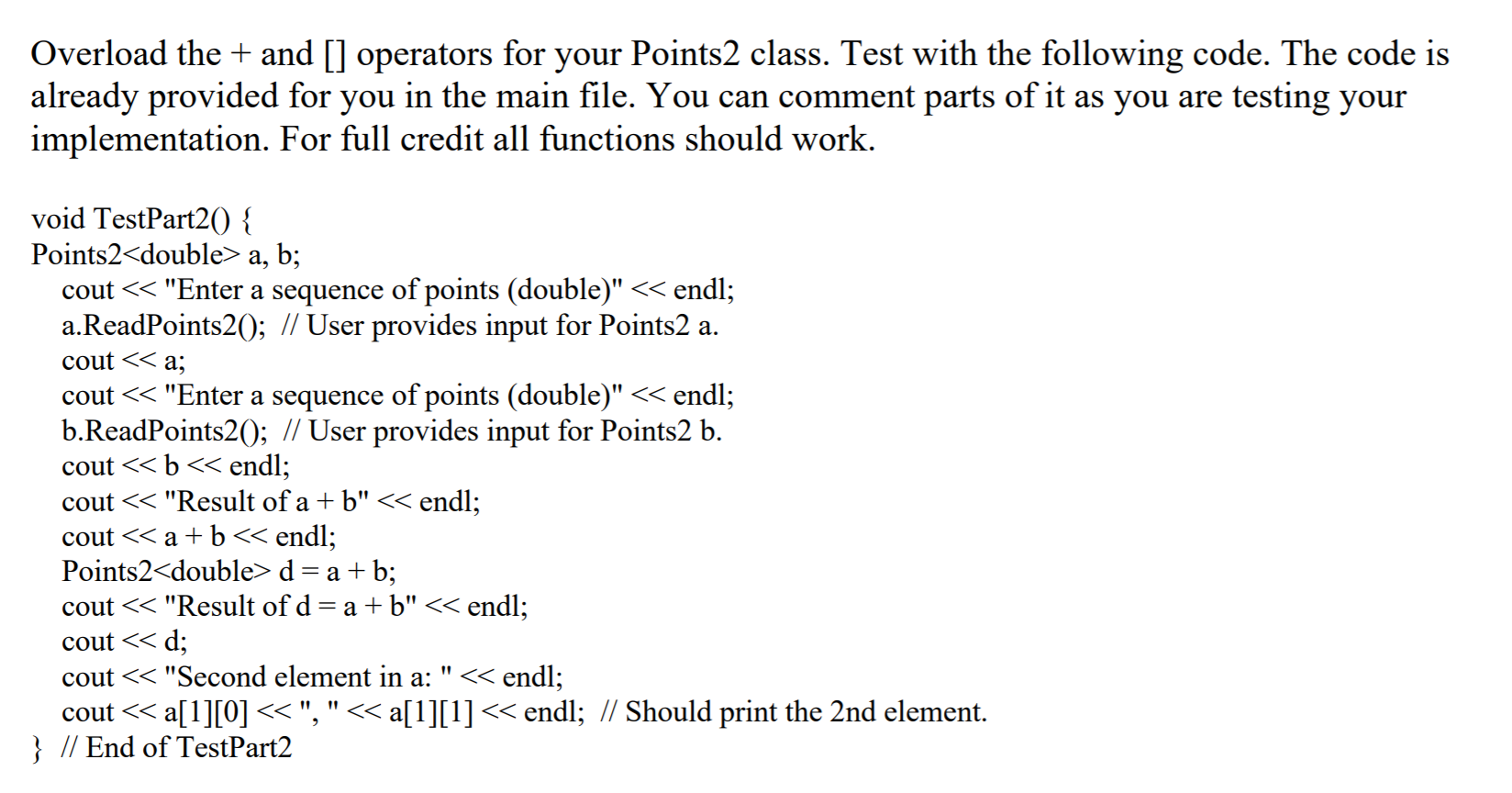
////Main File//////////////
#include
#include #include #include using namespace std; using namespace teaching_project;
// Place stand-alone function in unnamed namespace. namespace { void TestPart1() { Points2 a, b; // Two empty Points2 are created. cout
void TestPart2() { Points2 a, b; cout
} // namespace
int main(int argc, char **argv) { TestPart1(); TestPart2(); return 0; } ////////end main file//////////////////////////
///////point2 class///////////////
ifndef CSCI335_HOMEWORK1_POINTS2_H_ #define CSCI335_HOMEWORK1_POINTS2_H_ #include#include #include #include #include namespace teaching_project { // Place comments that provide a brief explanation of the class, // and its sample usage. template class Points2 { public: // Default "big five" -- you have to alter them for your assignment. // That means that you will remove the "= default" statement. // and you will provide an implementation. // Zero-parameter constructor. // Set size to 0. Points2() = default; // Copy-constructor. Points2(const Points2 &rhs) = default; // Copy-assignment. If you have already written // the copy-constructor and the move-constructor // you can just use: // { // Points2 copy = rhs; // std::swap(*this, copy); // return *this; // } Points2& operator=(const Points2 &rhs) = default; // Move-constructor. Points2(Points2 &&rhs) = default; // Move-assignment. // Just use std::swap() for all variables. Points2& operator=(Points2 &&rhs) = default; ~Points2() = default; // End of big-five. // One parameter constructor. Points2(const std::array
///////////end point2 class////////////////////
Overload the + and [] operators for your Points2 class. Test with the following code. The code is already provided for you in the main file. You can comment parts of it as you are testing your implementation. For full credit all functions should work. void TestPart20 { Points2
Step by Step Solution
There are 3 Steps involved in it

Get step-by-step solutions from verified subject matter experts
 Study Help