







Question: In C++ For option D, the instructions that explain the problem are the following: Context Most metals expand with heat and contract with cold. This
In C++
For option D, the instructions that explain the problem are the following:
Context
Most metals expand with heat and contract with cold. This feature has serious implications when the dimensions of a piece of laboratory equipment are Critics for an experiment. A typical aluminum bar that has w centimeters wide at 70 Fahrenheit degrees will be x centimeters wide at another temperature t. The value of x is calculated with the following formula:
x = w + (t - 70) * 10-4
Write a program that asks the user for the standard width of a bar at 70 degrees Fahrenheit and a tolerance for the variation in the width of the bar. Also request the initial and final temperature in degrees farenheit, and display a table containing the widths of the bar at temperatures that are in that range (between the initial temperature and the final entry), with temperature ranges of 1 degree. Place an asterisk (*) next to those bar widths that are within tolerance limits.
Remember to validate the input data with cycles.
When option D is selected, the screen should look as shown in the box below (the part of the data entry and the report that is generated is included).
Optional: To print the bar widths with 5 decimals and the decimal points of that column exit aligned investigate the use of setw, fixed and setprecision.
EXAMPLE OF SCREEN OUTPUT for option D (including data entry)
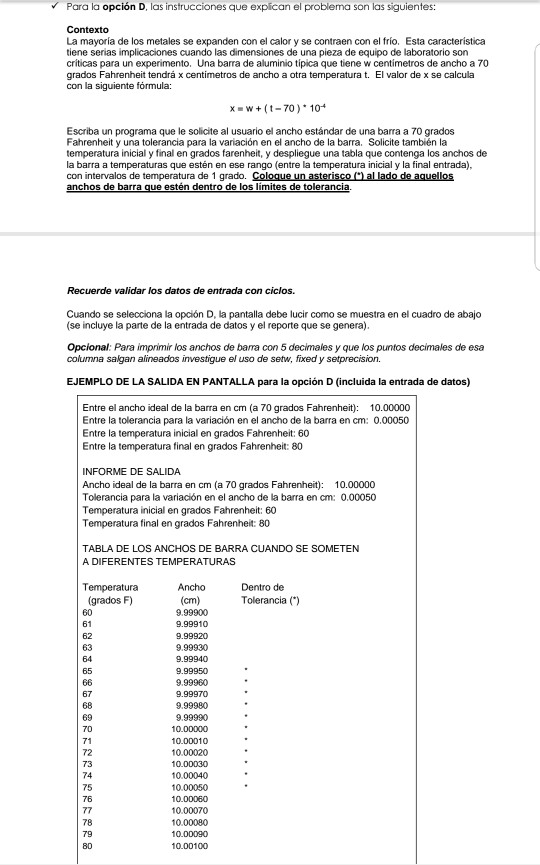
Para la opcin D, las instrucciones que expican el problema son las siguientes: La mayora de los metales se expanden con el calor y se contraen con el fro. Esta caracteristica tiene serias implicaciones cuando las dimensiones de una pieza de equipo de laboratorio son criticas para un experimento. Una barra de aluminio tipica que tiene w centimetros de ancho a 70 grados Fahrenheit tendr x centimetros de ancho a otra temperaturat. El valor de x se calcula con la siguiente formula: x--70) 10 Escriba un programa que le solicite al usuario el ancho estndar de una barra a 70 grados Fahrenheit y una tolerancia para la variacin en el ancho de la barra. Solicite tambin la temperatura inicial y final en grados farenheit, y despliegue una tabla que contenga los anchos de la barra a temperaturas que estn en ese rango (entre la temperatura inicial y la final entrada) cuu eaden grado. Caloaus un asterisco Cl al lade de aquellos estn dentro de los limites de toleranci Recuerde validar los datos de entrada con ciclos. Cuando se selecciona la opcin D, la pantalla debe lucir como se muestra en el cuadro de abajco (se incluye la parte de la entrada de datos y el reporte que se genera) Opcional: Para impnimir los anchos de barra con 5 decimales y que los puntos decimales de esa columna salgan alineados investigue el uso de setw, fixed y setprecision. EJEMPLO DE LA SALIDA EN PANTALLA para la opcin D (incluida la entrada de datos) Entre el ancho ideal de la barra en cm (a 70 grados Fahrenheit) 10.00000 Entre la tolerancia para la variacn en el ancho de la barra en cm: 0.00050 Entre la temperatura inicial en grados Fahrenheit: 60 Entre la temperatura final en grados Fahrenheit: 80 INFORME DE SALIDA Ancho ideal de la barra en cm (a 70 grados Fahrenhe) 10.00000 Tolerancia para la variacin en el ancho de la barra en cm: 0.00050 Temperatura inicial en grados Fahrenheit: 60 Temperatura final en grados Fahrenheit: 80 TABLA DE LOS ANCHOS DE BARRA CUANDO SE SOMETEN A DIFERENTES TEMPERATURAS Dentro de Tolerancia) (grados F) 60 61 (cm) 9.99900 9.99910 9.99920 9.99930 9.99940 9.99950 9.99960 9.9997 9.99980 9.99990 0.00000 0.00010 10.00020 0.00030 10.00040 10.00050 0.00060 10.00070 10.00080 0.00090 0.00100 63 70 71 73 75 76 78 79
Step by Step Solution
There are 3 Steps involved in it

Get step-by-step solutions from verified subject matter experts
 Study Help