







Question: In C Functional verification involves checking the behavior of some piece of code (or even entire program!) to verify that it complies with its specification.
In C
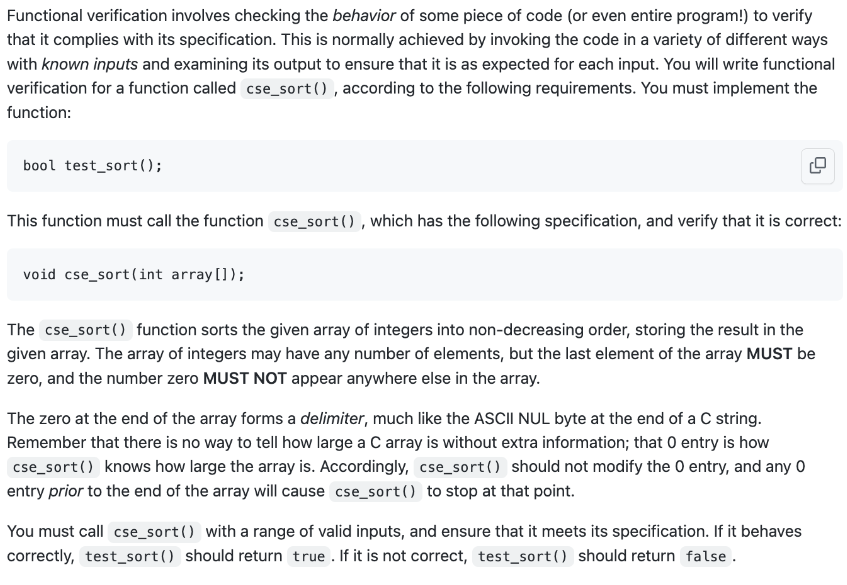
Functional verification involves checking the behavior of some piece of code (or even entire program!) to verify that it complies with its specification. This is normally achieved by invoking the code in a variety of different ways with known inputs and examining its output to ensure that it is as expected for each input. You will write functional verification for a function called , according to the following requirements. You must implement the function: bool test_sort () ; This function must call the function , which has the following specification, and verify that it is correct: void cse_sort (int array []); The function sorts the given array of integers into non-decreasing order, storing the result in the given array. The array of integers may have any number of elements, but the last element of the array MUST be zero, and the number zero MUST NOT appear anywhere else in the array. The zero at the end of the array forms a delimiter, much like the ASCII NUL byte at the end of a C string. Remember that there is no way to tell how large a C array is without extra information; that 0 entry is how knows how large the array is. Accordingly, cse_sort () should not modify the 0 entry, and any 0 entry prior to the end of the array will cause to stop at that point. You must call with a range of valid inputs, and ensure that it meets its specification. If it behaves correctly, should return . If it is not correct, test_sort () should return
Step by Step Solution
There are 3 Steps involved in it

Get step-by-step solutions from verified subject matter experts
 Study Help