







Question: in C++ Output should match example output #ifndef STASH_H #define STASH_H #include #include using namespace std; struct Stash { int size; // Size of each
in C++
Output should match example output
#ifndef STASH_H
#define STASH_H
#include
#include
using namespace std;
struct Stash {
int size; // Size of each space
int quantity; // Number of storage spaces
int next; // Next empty space
// Dynamically allocated array of bytes:
unsigned char* storage;
// Functions!
void initialize(int sz){
size = sz;
quantity = 0;
storage = 0;
next = 0;
}
void cleanup(){
if(storage != 0) {
std::cout
delete []storage;
}
}
int add(const void* element){
if(next >= quantity) // Enough space left?
inflate(100);
// Copy element into storage,
// starting at next empty space:
int startBytes = next * size;
unsigned char* e = (unsigned char*)element;
for(int i = 0; i
storage[startBytes + i] = e[i];
next++;
return(next - 1); // Index number
}
void* fetch(int index){
// Check index boundaries:
assert(0
if(index >= next)
return 0; // To indicate the end
// Produce pointer to desired element:
return &(storage[index * size]);
}
int count() {
return next; // Number of elements in CStash
}
void inflate(int increase){
assert(increase > 0);
int newQuantity = quantity + increase;
int newBytes = newQuantity * size;
int oldBytes = quantity * size;
unsigned char* b = new unsigned char[newBytes];
for(int i = 0; i
b[i] = storage[i]; // Copy old to new
delete []storage; // Old storage
storage = b; // Point to new memory
quantity = newQuantity;
}
}; ///:~
#endif
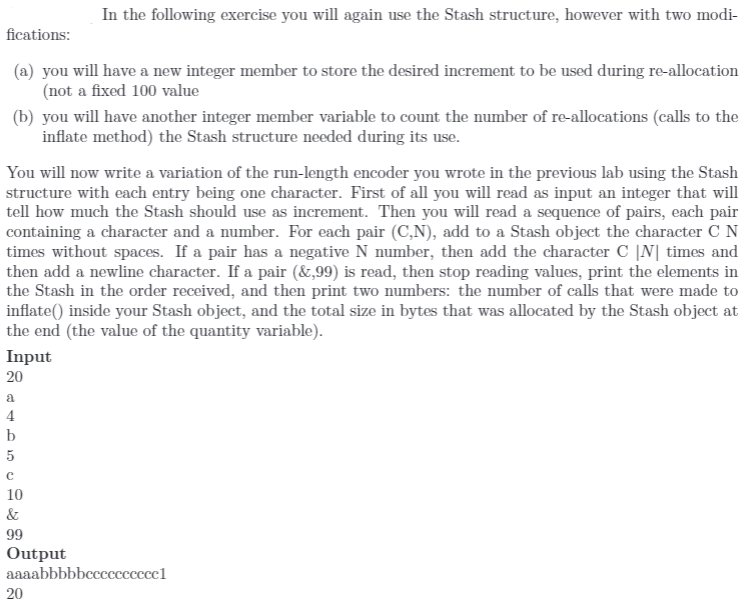
In the following exercise you will again use the Stash structure, however with two modi- fications: (a) you will have a new integer member to store the desired increment to be used during re-allocation (not a fixed 100 value (b) you will have another integer member variable to count the number of re-allocations (calls to the inflate method) the Stash structure needed during its use. You will now write a variation of the run-length encoder you wrote in the previous lab using the Stash structure with each entry being one character. First of all you will read as input an integer that will tell how much the Stash should use as increment. Then you will read a sequence of pairs, each pair containing a character and a number. For each pair (CN), add to a Stash object the character CN times without spaces. If a pair has a negative N number, then add the character C|N| times and then add a newline character. If a pair (&,99) is read, then stop reading values, print the elements in the Stash in the order received, and then print two numbers: the number of calls that were made to inflate() inside your Stash object, and the total size in bytes that was allocated by the Stash object at the end (the value of the quantity variable). Input 20 a 4 b 5 10 & 99 Output aaaabbbbbcccccccccc1 20 In the following exercise you will again use the Stash structure, however with two modi- fications: (a) you will have a new integer member to store the desired increment to be used during re-allocation (not a fixed 100 value (b) you will have another integer member variable to count the number of re-allocations (calls to the inflate method) the Stash structure needed during its use. You will now write a variation of the run-length encoder you wrote in the previous lab using the Stash structure with each entry being one character. First of all you will read as input an integer that will tell how much the Stash should use as increment. Then you will read a sequence of pairs, each pair containing a character and a number. For each pair (CN), add to a Stash object the character CN times without spaces. If a pair has a negative N number, then add the character C|N| times and then add a newline character. If a pair (&,99) is read, then stop reading values, print the elements in the Stash in the order received, and then print two numbers: the number of calls that were made to inflate() inside your Stash object, and the total size in bytes that was allocated by the Stash object at the end (the value of the quantity variable). Input 20 a 4 b 5 10 & 99 Output aaaabbbbbcccccccccc1 20
Step by Step Solution
There are 3 Steps involved in it

Get step-by-step solutions from verified subject matter experts
 Study Help