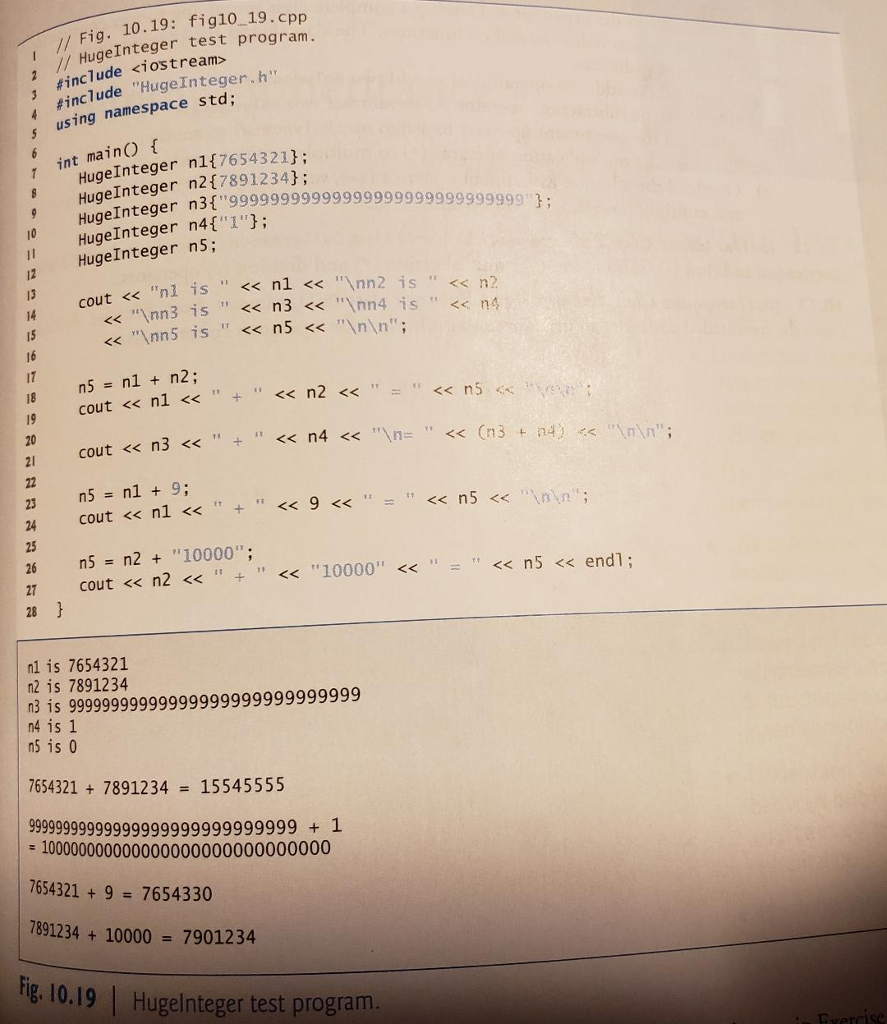
Question: ? in C++ please Fig. 10.16 | Complex class test program. (Part 2 of 2.) can represent integers in approximately-2 billion to +2 billion. This
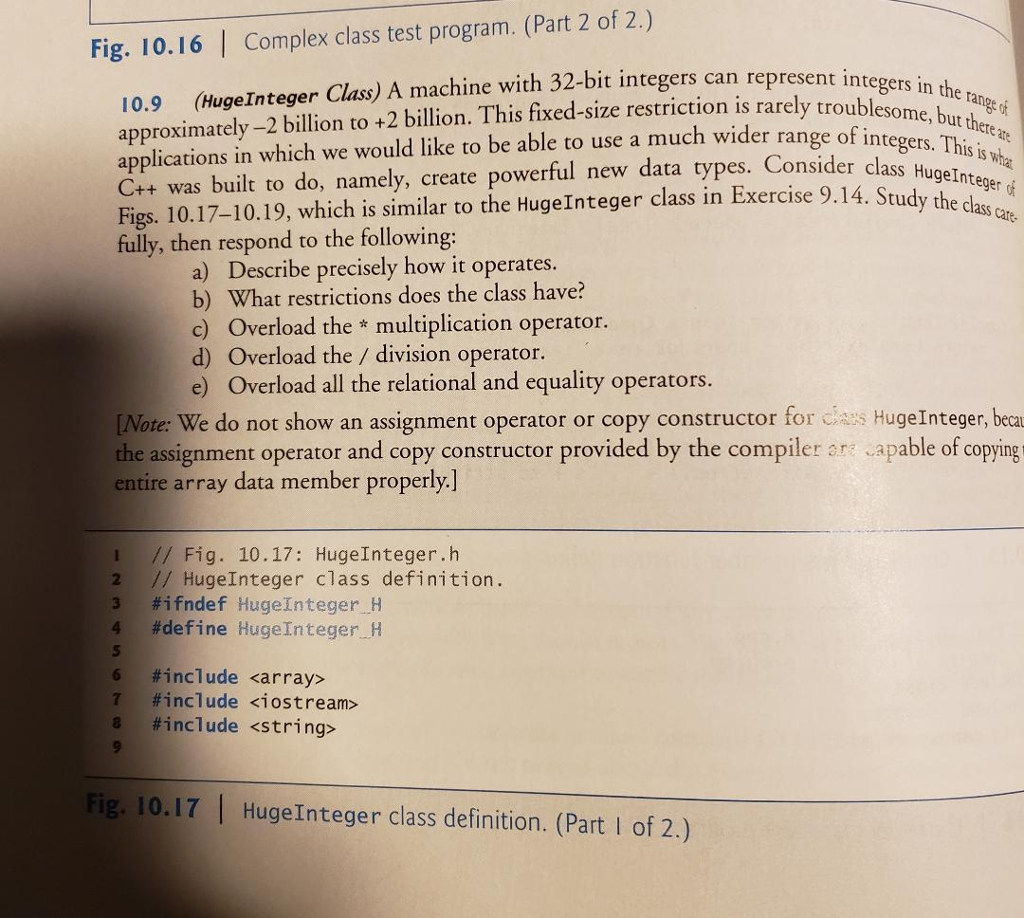
? in C++ please Fig. 10.16 | Complex class test program. (Part2 of 2.) can represent integers in approximately-2 billion to +2 billion.This fixed-size restriction is rarely troublesome, ihe an applications in which wewould like to be able to use a much wider range ofintegers. T (HugeInteger Clas) A machine with 32-bit integers ublesome, but there? in C++ please

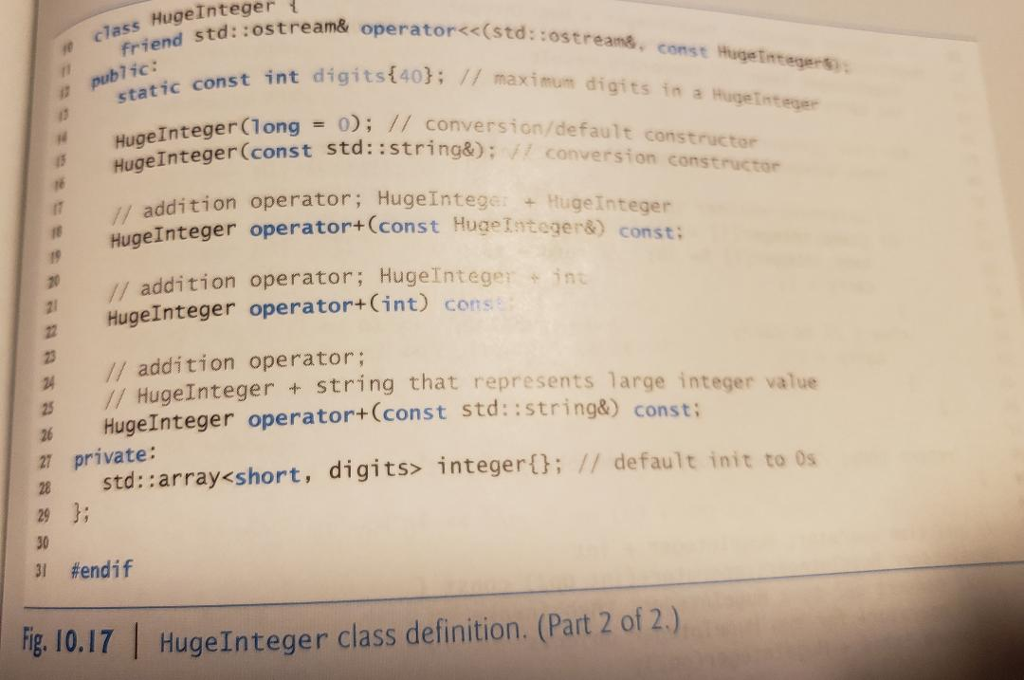
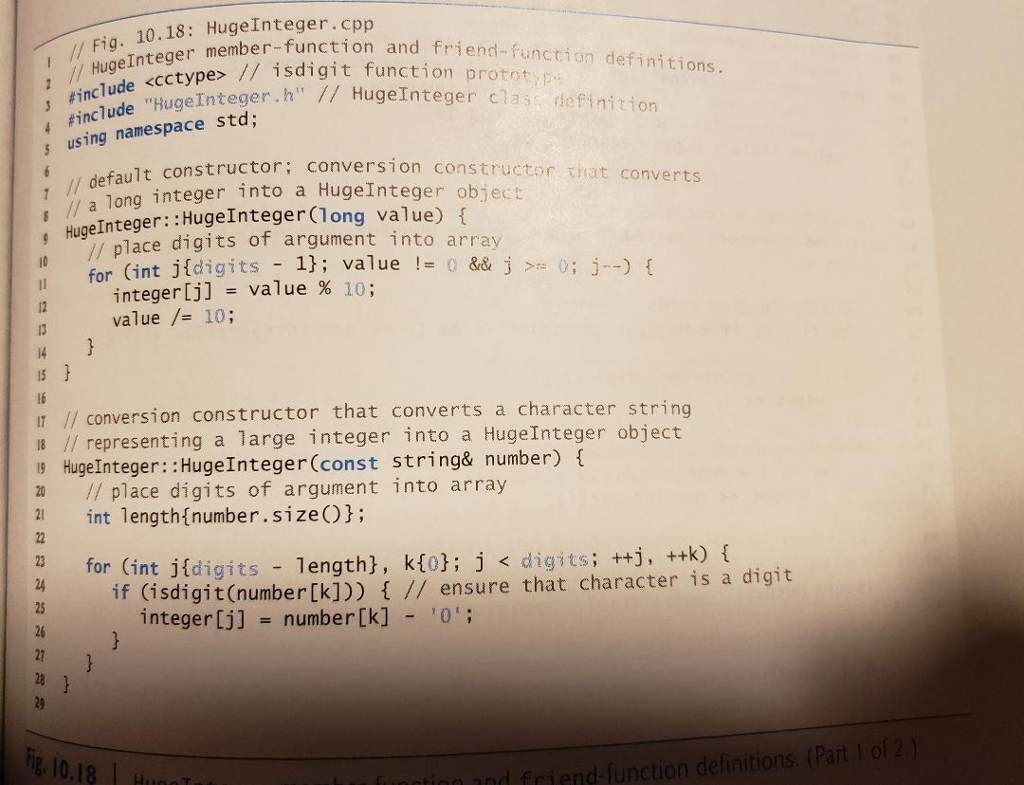
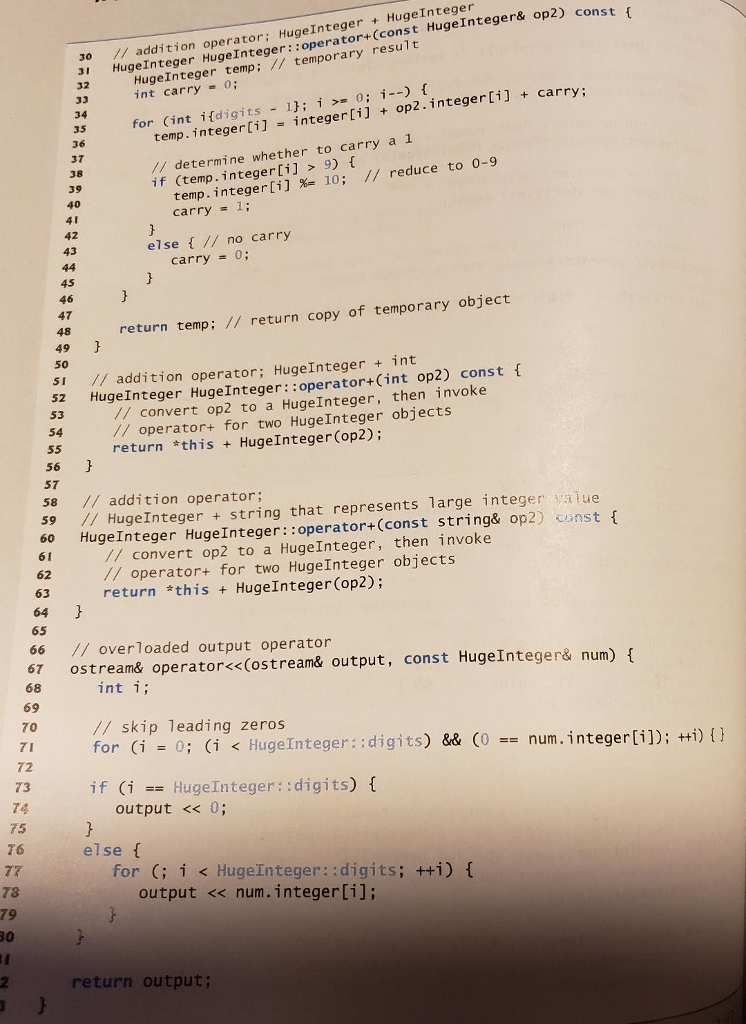
Fig. 10.16 | Complex class test program. (Part 2 of 2.) can represent integers in approximately-2 billion to +2 billion. This fixed-size restriction is rarely troublesome, ihe an applications in which we would like to be able to use a much wider range of integers. T (HugeInteger Clas) A machine with 32-bit integers ublesome, but there at 10.9 Ct+ was built to do, namely, create powerful new data types. Consider class H Figs. 10.17-10.19, which is similar to the HugeInteger class in Exercise 9.14. Stuy tht fully, then respond to the followin Hugeinteger f a) Describe precisely how it operates. b) What restrictions does the class have? Overload the * multiplication operator. d) Overload the / division operator e) Overload all the relational and equality operators. [Note: We do not show an assignment operator or copy constructor for cass Huge Integer, bea the assignment operator and copy constructor provided by the compiler ar apable of copying entire array data member properly.] 1// Fig. 10.17: HugeInteger.h 2 // HugeInteger class definition. #ifndef HugeIntegerH #define HugeInteger_H #include #include #include Fig. 10.17 HugeInteger class definition. (Part I of 2.) Fig. 10.16 | Complex class test program. (Part 2 of 2.) can represent integers in approximately-2 billion to +2 billion. This fixed-size restriction is rarely troublesome, ihe an applications in which we would like to be able to use a much wider range of integers. T (HugeInteger Clas) A machine with 32-bit integers ublesome, but there at 10.9 Ct+ was built to do, namely, create powerful new data types. Consider class H Figs. 10.17-10.19, which is similar to the HugeInteger class in Exercise 9.14. Stuy tht fully, then respond to the followin Hugeinteger f a) Describe precisely how it operates. b) What restrictions does the class have? Overload the * multiplication operator. d) Overload the / division operator e) Overload all the relational and equality operators. [Note: We do not show an assignment operator or copy constructor for cass Huge Integer, bea the assignment operator and copy constructor provided by the compiler ar apable of copying entire array data member properly.] 1// Fig. 10.17: HugeInteger.h 2 // HugeInteger class definition. #ifndef HugeIntegerH #define HugeInteger_H #include #include #include Fig. 10.17 HugeInteger class definition. (Part I of 2.)
Step by Step Solution

There are 3 Steps involved in it

1 Expert Approved Answer
Step: 1 Unlock blur-text-image
Question Has Been Solved by an Expert!

Get step-by-step solutions from verified subject matter experts

Step: 2 Unlock
Step: 3 Unlock

Students Have Also Explored These Related Databases Questions!