







Question: In C++ please Statistics are often calculated with varying amounts of input data. Write a program that takes any number of non-negative integers as input,
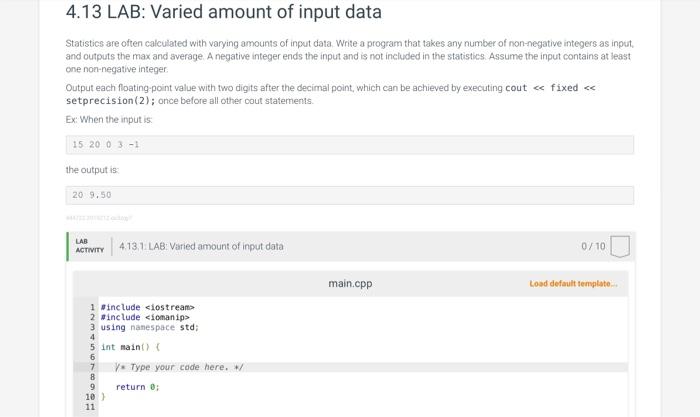
Statistics are often calculated with varying amounts of input data. Write a program that takes any number of non-negative integers as input, and outputs the max and average. A negative integer ends the input and is not included in the statistics. Assume the input contains at least one non-negative integer. Output each floating point value with two digits after the decimal point, which can be achieved by executing cout fixed setprecision (2); once before all other cout statemens. Ex: When the input is: 1520031 the output is: 20.9.50 Statistics are often calculated with varying amounts of input data. Write a program that takes any number of non-negative integers as input, and outputs the max and average. A negative integer ends the input and is not included in the statistics. Assume the input contains at least one non-negative integer. Output each floating point value with two digits after the decimal point, which can be achieved by executing cout fixed setprecision (2); once before all other cout statemens. Ex: When the input is: 1520031 the output is: 20.9.50
Step by Step Solution
There are 3 Steps involved in it

Get step-by-step solutions from verified subject matter experts
 Study Help