Question: In Chapter 2, the table on Management Ideas and Practices throughout History fails to include biblical references. After reading Exodus 18:31-23, what management practices are
In Chapter 2, the table on "Management Ideas and Practices throughout History" fails to include biblical references. After reading Exodus 18:31-23, what management practices are evident in these passages? How could those practices easily be applied to everyday work life?
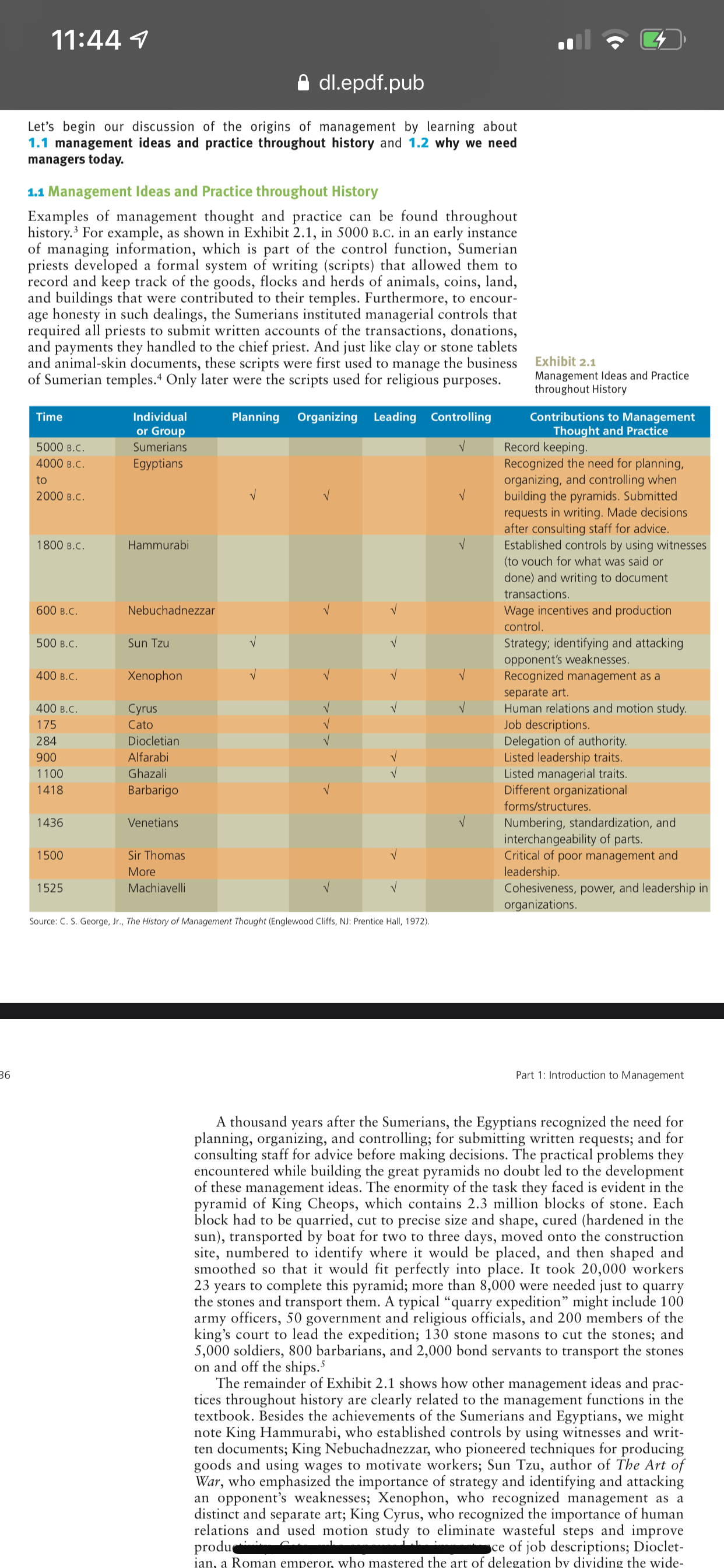
11:44 7 A dl.epdf.pub Let's begin our discussion of the origins of management by learning about 1.1 management ideas and practice throughout history and 1.2 why we need managers today. 1.1 Management Ideas and Practice throughout History Examples of management thought and practice can be found throughout history.' For example, as shown in Exhibit 2.1, in 5000 B.C. in an early instance of managing information, which is part of the control function, Sumerian priests developed a formal system of writing (scripts) that allowed them to record and keep track of the goods, flocks and herds of animals, coins, land, and buildings that were contributed to their temples. Furthermore, to encour age honesty in such dealings, the Sumerians instituted managerial controls that required all priests to submit written accounts of the transactions, donations, and payments they handled to the chief priest. And just like clay or stone tablets and animal-skin documents, these scripts were first used to manage the business Exhibit 2.1 of Sumerian temples.4 Only later were the scripts used for religious purposes. Management Ideas and Practice throughout History Time Individual Planning Organizing Leading Controlling Contributions to Management or Group Thought and Practice 5000 B.C. Sumerians V Record keeping. 4000 B.C. Egyptians Recognized the need for planning, to organizing, and controlling when 2000 B.C. V V building the pyramids. Submitted requests in writing. Made decisions after consulting staff for advice. 1800 B.C. Hammurabi V Established controls by using witnesses (to vouch for what was said or done) and writing to document transactions. 600 B.C. Nebuchadnezzar Wage incentives and production control. 500 B.C. Sun Tzu Strategy; identifying and attacking opponent's weaknesses 400 B.C. Xenophon Recognized management as a separate art. 400 B.C. Cyrus Human relations and motion study. 175 Cato Job descriptions. 284 Diocletian Delegation of authority. 900 Alfarabi Listed leadership traits. 1 100 Ghazali Listed managerial traits. 1418 Barbarigo Different organizational forms/structures. 1436 Venetians Numbering, standardization, and interchangeability of parts. 1500 Sir Thomas Critical of poor management and More leadership. 1525 Machiavelli V V Cohesiveness, power, and leadership in organizations. Source: C. S. George, Jr., The History of Management Thought (Englewood Cliffs, NJ: Prentice Hall, 1972). Part 1: Introduction to Management A thousand years after the Sumerians, the Egyptians recognized the need for planning, organizing, and controlling; for submitting written requests; and for consulting staff for advice before making decisions. The practical problems they encountered while building the great pyramids no doubt led to the development of these management ideas. The enormity of the task they faced is evident in the pyramid of King Cheops, which contains 2.3 million blocks of stone. Each block had to be quarried, cut to precise size and shape, cured (hardened in the sun), transported by boat for two to three days, moved onto the construction site, numbered to identify where it would be placed, and then shaped and smoothed so that it would fit perfectly into place. It took 20,000 workers 23 years to complete this pyramid; more than 8,000 were needed just to quarry the stones and transport them. A typical "quarry expedition" might include 100 army officers, 50 government and religious officials, and 200 members of the king's court to lead the expedition; 130 stone masons to cut the stones; and 5,000 soldiers, 800 barbarians, and 2,000 bond servants to transport the stones on and off the ships.' The remainder of Exhibit 2.1 shows how other management ideas and prac- tices throughout history are clearly related to the management functions in the textbook. Besides the achievements of the Sumerians and Egyptians, we might note King Hammurabi, who established controls by using witnesses and writ- ten documents; King Nebuchadnezzar, who pioneered techniques for producing goods and using wages to motivate workers; Sun Tzu, author of The Art of War, who emphasized the importance of strategy and identifying and attacking an opponent's weaknesses; Xenophon, who recognized management as a distinct and separate art; King Cyrus, who recognized the importance of human relations and used motion study to eliminate wasteful steps and improve produ ce of job descriptions; Dioclet- a Ro f delegation by dividing the









 Study Help