Question: In chapter 4, we learned about three main research design types: 1. Exploratory 2. Descriptive 3. Causal In this assignment, you are given six individual
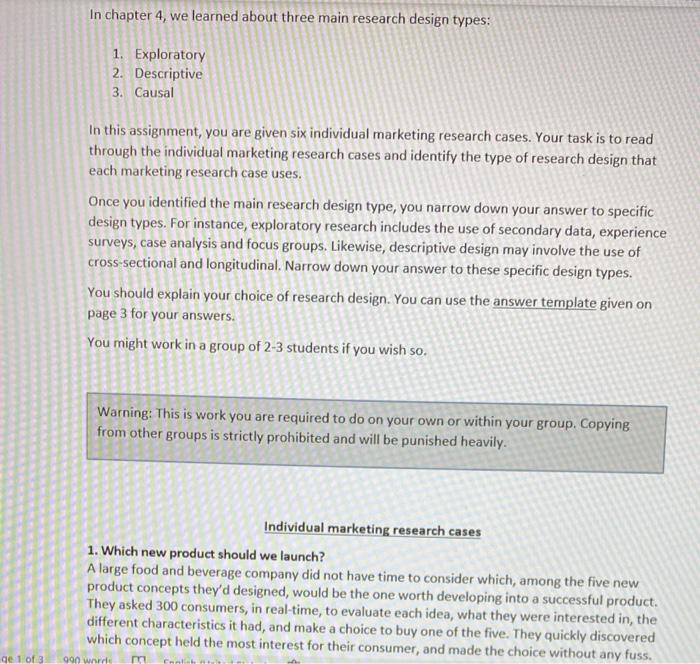
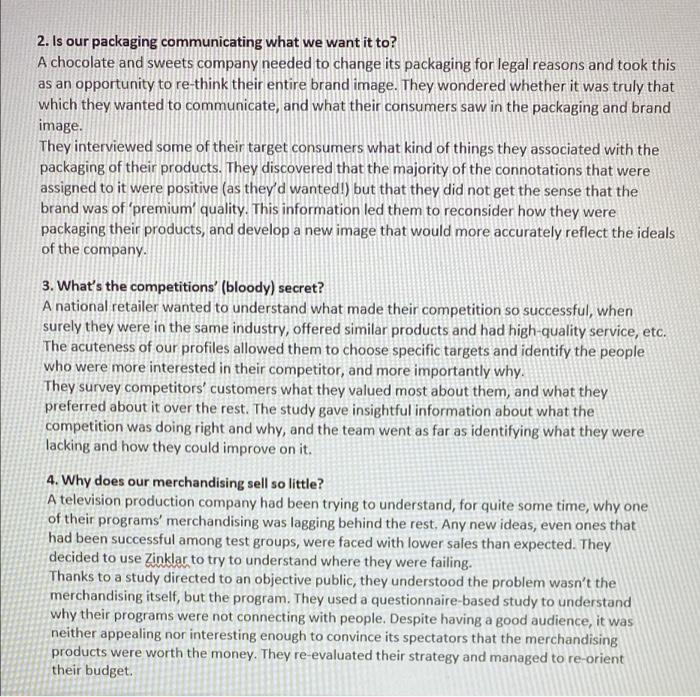
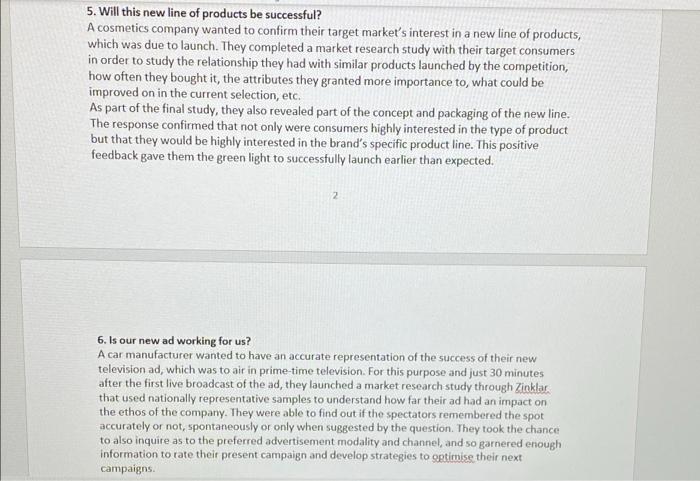
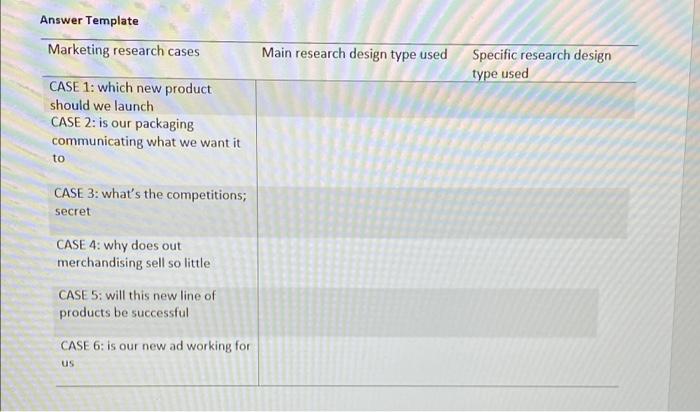
In chapter 4, we learned about three main research design types: 1. Exploratory 2. Descriptive 3. Causal In this assignment, you are given six individual marketing research cases. Your task is to read through the individual marketing research cases and identify the type of research design that each marketing research case uses. Once you identified the main research design type, you narrow down your answer to specific design types. For instance, exploratory research includes the use of secondary data, experience surveys, case analysis and focus groups. Likewise, descriptive design may involve the use of cross-sectional and longitudinal. Narrow down your answer to these specific design types. You should explain your choice of research design. You can use the answer template given on page 3 for your answers. You might work in a group of 2-3 students if you wish so. Warning: This is work you are required to do on your own or within your group. Copying from other groups is strictly prohibited and will be punished heavily. Individual marketing research cases 1. Which new product should we launch? A large food and beverage company did not have time to consider which, among the five new product concepts they'd designed, would be the one worth developing into a successful product. They asked 300 consumers, in real-time, to evaluate each idea, what they were interested in the different characteristics it had, and make a choice to buy one of the five. They quickly discovered which concept held the most interest for their consumer, and made the choice without any fuss. ge 1 of 3 990 w 2. Is our packaging communicating what we want it to? A chocolate and sweets company needed to change its packaging for legal reasons and took this as an opportunity to re-think their entire brand image. They wondered whether it was truly that which they wanted to communicate, and what their consumers saw in the packaging and brand image. They interviewed some of their target consumers what kind of things they associated with the packaging of their products. They discovered that the majority of the connotations that were assigned to it were positive (as they'd wanted!) but that they did not get the sense that the brand was of premium quality. This information led them to reconsider how they were packaging their products, and develop a new image that would more accurately reflect the ideals of the company. 3. What's the competitions' (bloody) secret? A national retailer wanted to understand what made their competition so successful, when surely they were in the same industry, offered similar products and had high-quality service, etc. The acuteness of our profiles allowed them to choose specific targets and identify the people who were more interested in their competitor, and more importantly why. They survey competitors' customers what they valued most about them, and what they preferred about it over the rest. The study gave insightful information about what the competition was doing right and why, and the team went as far as identifying what they were lacking and how they could improve on it. 4. Why does our merchandising sell so little? A television production company had been trying to understand, for quite some time, why one of their programs' merchandising was lagging behind the rest. Any new ideas, even ones that had been successful among test groups, were faced with lower sales than expected. They decided to use Zinklar to try to understand where they were failing. Thanks to a study directed to an objective public, they understood the problem wasn't the merchandising itself, but the program. They used a questionnaire-based study to understand why their programs were not connecting with people. Despite having a good audience, it was neither appealing nor interesting enough to convince its spectators that the merchandising products were worth the money. They re-evaluated their strategy and managed to re-orient their budget. 5. Will this new line of products be successful? A cosmetics company wanted to confirm their target market's interest in a new line of products, which was due to launch. They completed a market research study with their target consumers in order to study the relationship they had with similar products launched by the competition, how often they bought it, the attributes they granted more importance to what could be improved on in the current selection, etc. As part of the final study, they also revealed part of the concept and packaging of the new line. The response confirmed that not only were consumers highly interested in the type of product but that they would be highly interested in the brand's specific product line. This positive feedback gave them the green light to successfully launch earlier than expected. 2 6. Is our new ad working for us? A car manufacturer wanted to have an accurate representation of the success of their new television ad, which was to air in prime-time television. For this purpose and just 30 minutes after the first live broadcast of the ad, they launched a market research study through Zinklar that used nationally representative samples to understand how far their ad had an impact on the ethos of the company. They were able to find out if the spectators remembered the spot accurately or not, spontaneously or only when suggested by the question. They took the chance to also inquire as to the preferred advertisement modality and channel, and so garnered enough information to rate their present campaign and develop strategies to optimise their next campaigns Answer Template Marketing research cases Main research design type used Specific research design type used CASE 1: which new product should we launch CASE 2: is our packaging communicating what we want it to CASE 3: what's the competitions, secret CASE 4: why does out merchandising sell so little CASE 5: Will this new line of products be successful CASE 6: is our new ad working for Us









 Study Help