







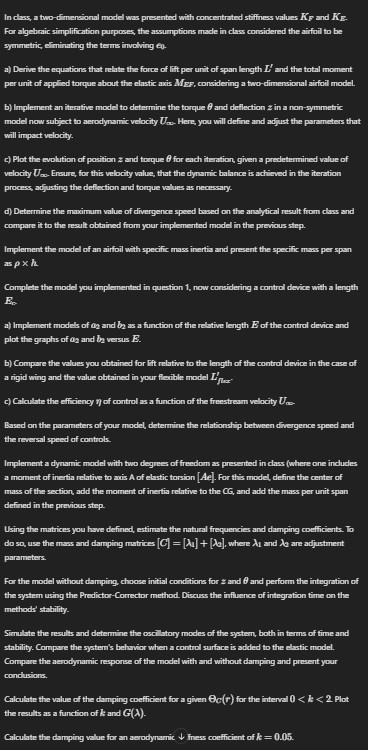
Question: In class, a two - dimensional model was presented with concentrated stiffness values K F and K E . For algebraic simplification purposes, the assumptions
In class, a twodimensional model was presented with concentrated stiffness values and
For algebraic simplification purposes, the assumptions made in class considered the airfoil to be symmetric, elininating the terms invalving e
a Derive the equations that rebate the farce of lift per unit of span length and the tatal moment per unit of appled torque about the elastic axis MEE, considering a twodimencional aiffoil model.
b Implement an iterstive model to determine the torque and deffection in a nonsymmetric
model now subject to aerodynamic velocity Here, you will define and adjust the parmeters that
will impact velocity.
c Plot the evolution of pasition and torque for each itteration, given a predetermined value of
velocity Ensure, for this velocity value, that the dynamic balance is accieved in the iteration
process, adfusting the deffection and torque values as necessary.
d Determine the maximum value of divergence speed based on the andytical result from chass and
compare it to the ressult obtained from your implemented model in the previous step.
Implement the model of an airfoil with specific masx inertia and present the specific mass per span
as
Complete the model you implamentad in question now considering a control device with a length
a Implement modets of and as a function of the relative length of the control device and
plat the graphs of and versus
b Compare the values you obtained for lft relative to the length of the control device in the case of
a rigid wing and the value obtained in your flecible model
c Calculate the efficiency of control as a function of the freestream velocity
Based on the parameters of your model, determine the relationship between divergence speed and
the reversal speed of controls.
Implement a dynamic model with two degrees of freedom as presented in class where one includes
a moment of inertia relative to axis A of elastic torsion Ae For ths model, define the center of
mass of the section, add the moment of inertia relative to the CG and add the mass per unit span
defined in the previsus step.
Using the matrices you hwwe defined, estimste the natural frequencies and damping coefficients. To
do sa use the mass and darnping matrices where and are adjustment
parameter.
For the model without darnping, chaose initisl conditions for and and perform the integration of
the system using the PredictorCorrectar method. Discass the influence of integration time on the
methods' stability.
Simulate the results and determine the oscilistory modes of the system, both in terms of time and
stability. Compare the syatem's behavior when a contral surface is added to the efastic model.
Compare the aerodjynamic response of the model with and without damping and present your
condtusions.
Calculate the value of the damping coefficient for a given for the interval Plot
the resilts a function and
Calculate the damping value for acrodynamic darr fness cocfficient
Step by Step Solution
There are 3 Steps involved in it
1 Expert Approved Answer
Step: 1 Unlock

Question Has Been Solved by an Expert!
Get step-by-step solutions from verified subject matter experts
Step: 2 Unlock
Step: 3 Unlock
 Study Help