



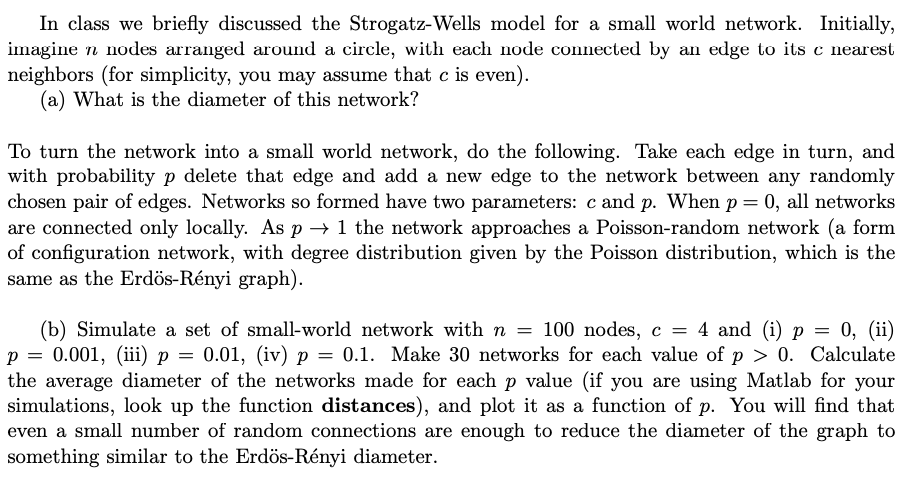
Question: In class we briefly discussed the Strogatz - Wells model for a small world network. Initially, imagine n nodes arranged around a circle, with each
In class we briefly discussed the StrogatzWells model for a small world network. Initially,
imagine nodes arranged around a circle, with each node connected by an edge to its nearest
neighbors for simplicity, you may assume that is even
a What is the diameter of this network?
To turn the network into a small world network, do the following. Take each edge in turn, and
with probability delete that edge and add a new edge to the network between any randomly
chosen pair of edges. Networks so formed have two parameters: and When all networks
are connected only locally. As the network approaches a Poissonrandom network a form
of configuration network, with degree distribution given by the Poisson distribution, which is the
same as the ErdsRnyi graph
b Simulate a set of smallworld network with nodes, and iii
iiiiv Make networks for each value of Calculate
the average diameter of the networks made for each value if you are using Matlab for your
simulations, look up the function distances and plot it as a function of You will find that
even a small number of random connections are enough to reduce the diameter of the graph to
something similar to the ErdsRnyi diameter.
Step by Step Solution
There are 3 Steps involved in it
1 Expert Approved Answer
Step: 1 Unlock

Question Has Been Solved by an Expert!
Get step-by-step solutions from verified subject matter experts
Step: 2 Unlock
Step: 3 Unlock