







Question: In class we discuss the assignment game (P, Q, a). In this question we interpret P as a set of bidders and Q as a
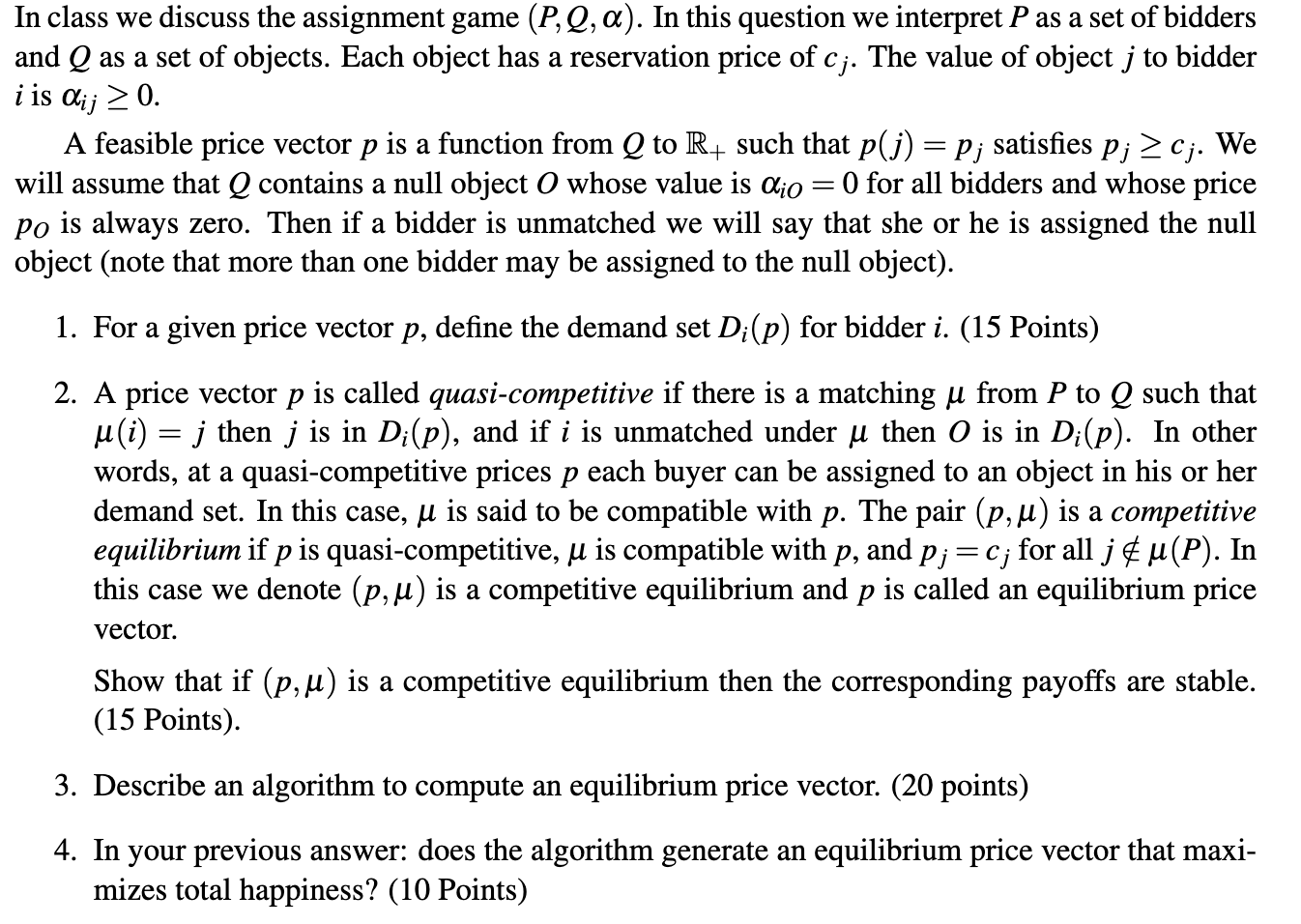
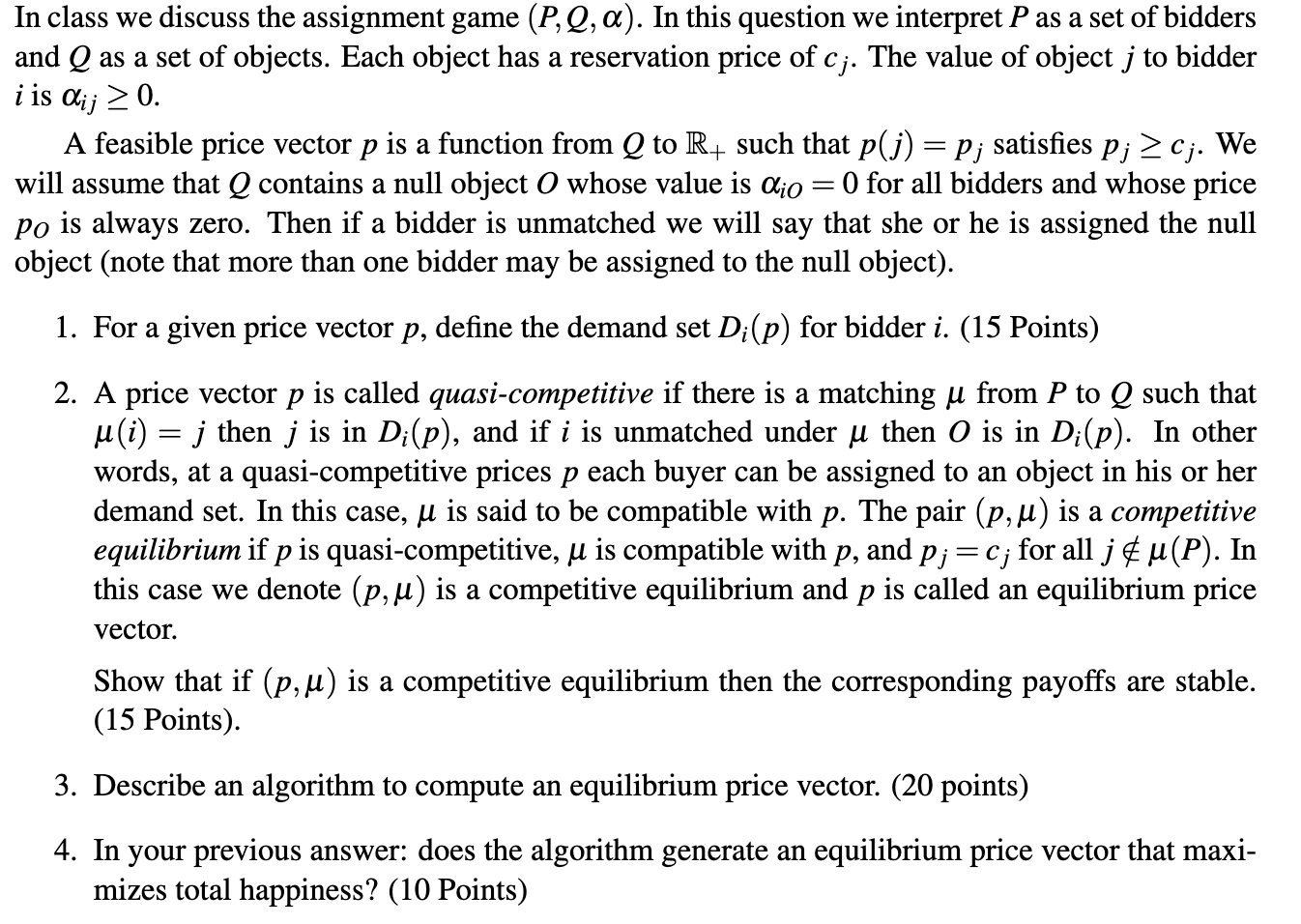
In class we discuss the assignment game (P, Q, a). In this question we interpret P as a set of bidders and Q as a set of objects. Each object has a reservation price of C}. The value of object j to bidder 1: IS a\": 2 0. A feasible price vector p is a function from Q to R+ such that p( j) : pj satises pj 2 cf. We will assume that Q contains a null object 0 whose value is 06:0 : 0 for all bidders and whose price p0 is always zero. Then if a bidder is unmatched we will say that she or he is assigned the null object (note that more than one bidder may be assigned to the null object). 1. For a given price vector p, dene the demand set D; (p) for bidder i. (15 Points) 2. A price vector p is called quasi-competitive if there is a matching [,1 from P to Q such that \"(i) : j then j is in D303), and if i is unmatched under p then 0 is in D;(p). In other words, at a quasi-competitive prices p each buyer can be assigned to an object in his or her demand set. In this case, p is said to be compatible with p. The pair (p, p) is a competitive equilibrium if p is quasi-competitive, u is compatible with p, and p J,- : of for all j (2 \"(P). In this case we denote (p41) is a competitive equilibrium and p is called an equilibrium price vector. Show that if (19,\") is a competitive equilibrium then the corresponding payoffs are stable. (15 Points). 3. Describe an algorithm to compute an equilibrium price vector. (20 points) 4. In your previous answer: does the algorithm generate an equilibrium price vector that maxi mizes total happiness? (10 Points)
Step by Step Solution
There are 3 Steps involved in it

Get step-by-step solutions from verified subject matter experts
 Study Help