



Question: In class, we studied product line pricing for substitute goods. Let's now consider the case of complementary goods. Consider a market with 2 types
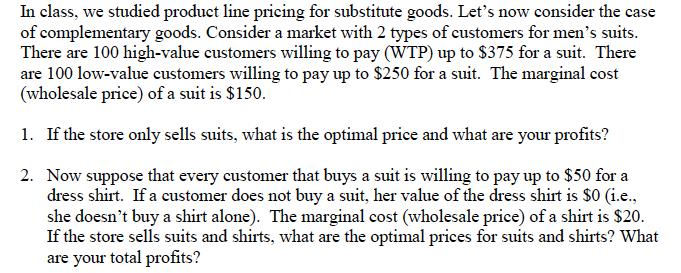
In class, we studied product line pricing for substitute goods. Let's now consider the case of complementary goods. Consider a market with 2 types of customers for men's suits. There are 100 high-value customers willing to pay (WTP) up to $375 for a suit. There are 100 low-value customers willing to pay up to $250 for a suit. The marginal cost (wholesale price) of a suit is $150. 1. If the store only sells suits, what is the optimal price and what are your profits? 2. Now suppose that every customer that buys a suit is willing to pay up to $50 for a dress shirt. If a customer does not buy a suit, her value of the dress shirt is $0 (i.e.. she doesn't buy a shirt alone). The marginal cost (wholesale price) of a shirt is $20. If the store sells suits and shirts, what are the optimal prices for suits and shirts? What are your total profits?
Step by Step Solution
3.49 Rating (146 Votes )
There are 3 Steps involved in it
SOLUTION To determine the optimal prices and profits in both scenarios well apply the concept of profit maximization given the customer segments and their willingness to pay WTP 1 Selling Suits Only I... View full answer

Get step-by-step solutions from verified subject matter experts