







Question: In class, we talked about -reduction (reduction via capture-avoiding substitution) and -conversion (variable renaming). These two rules can be used to fully describe the semantics
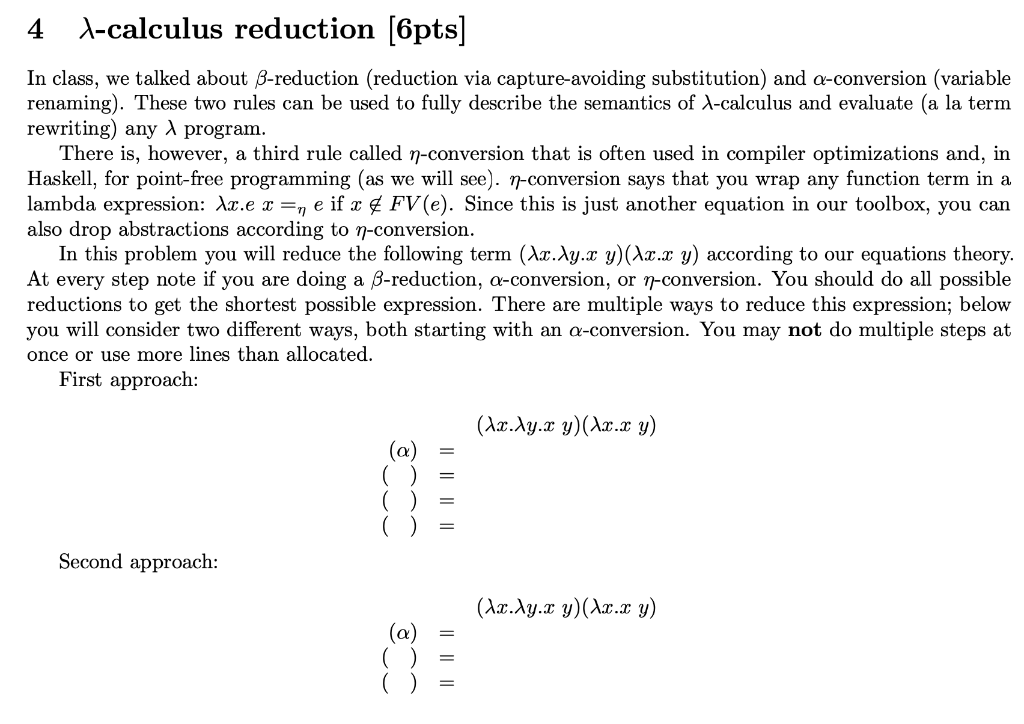
In class, we talked about -reduction (reduction via capture-avoiding substitution) and -conversion (variable renaming). These two rules can be used to fully describe the semantics of -calculus and evaluate (a la term rewriting) any program. There is, however, a third rule called -conversion that is often used in compiler optimizations and, in Haskell, for point-free programming (as we will see). -conversion says that you wrap any function term in a lambda expression: x.ex=e if x/FV(e). Since this is just another equation in our toolbox, you can also drop abstractions according to -conversion. In this problem you will reduce the following term (x.y.xy)(x.xy) according to our equations theory. At every step note if you are doing a -reduction, -conversion, or -conversion. You should do all possible reductions to get the shortest possible expression. There are multiple ways to reduce this expression; below you will consider two different ways, both starting with an -conversion. You may not do multiple steps at once or use more lines than allocated. First approach: ()=(xyxy)(xxy)()=()=()= Second approach: ()=(xyxy)(xxy)()=()=
Step by Step Solution
There are 3 Steps involved in it

Get step-by-step solutions from verified subject matter experts
 Study Help