







Question: In class we walked through the basic processing of a simple section of code, in terms of the basic operations of the pieces of a
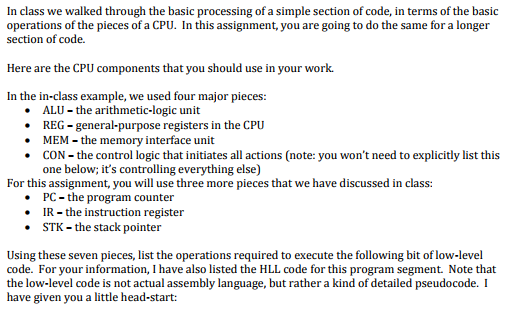
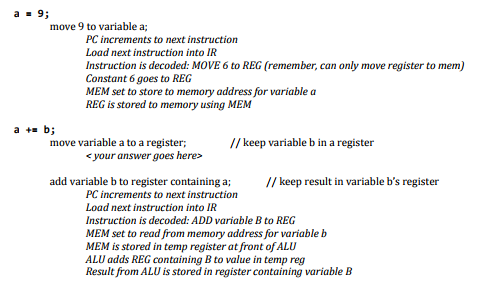
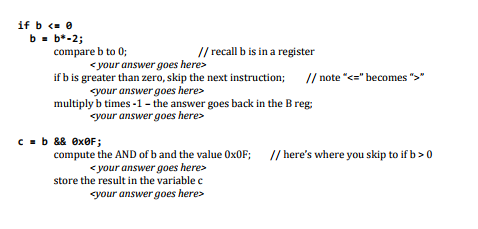
In class we walked through the basic processing of a simple section of code, in terms of the basic operations of the pieces of a CPU. In this assignment, you are going to do the same for a longer section of code. Here are the CPU components that you should use in your work. In the in-class example, we used four major pieces ALU -the arithmetic-logic unit REG-general-purpose registers in the CPU MEM- the memory interface unit CON-the control logic that initiates all actions (note: you won't need to explicitly list this one below; it's controlling everything else) For this assignment, you will use three more pieces that we have discussed in class: PC the program counter IR- the instruction register STK - the stack pointer . Using these seven pieces, list the operations required to execute the following bit of low-level code. For your information, I have also listed the HLL code for this program segment. Note that the low-level code is not actual assembly language, but rather a kind of detailed pseudocode. I have given you a little head-start: In class we walked through the basic processing of a simple section of code, in terms of the basic operations of the pieces of a CPU. In this assignment, you are going to do the same for a longer section of code. Here are the CPU components that you should use in your work. In the in-class example, we used four major pieces ALU -the arithmetic-logic unit REG-general-purpose registers in the CPU MEM- the memory interface unit CON-the control logic that initiates all actions (note: you won't need to explicitly list this one below; it's controlling everything else) For this assignment, you will use three more pieces that we have discussed in class: PC the program counter IR- the instruction register STK - the stack pointer . Using these seven pieces, list the operations required to execute the following bit of low-level code. For your information, I have also listed the HLL code for this program segment. Note that the low-level code is not actual assembly language, but rather a kind of detailed pseudocode. I have given you a little head-start
Step by Step Solution
There are 3 Steps involved in it

Get step-by-step solutions from verified subject matter experts
 Study Help