







Question: In each case construct, if possible, a binary (n, M, d)-code. If no such code exists, explain why. You can use any of the coding
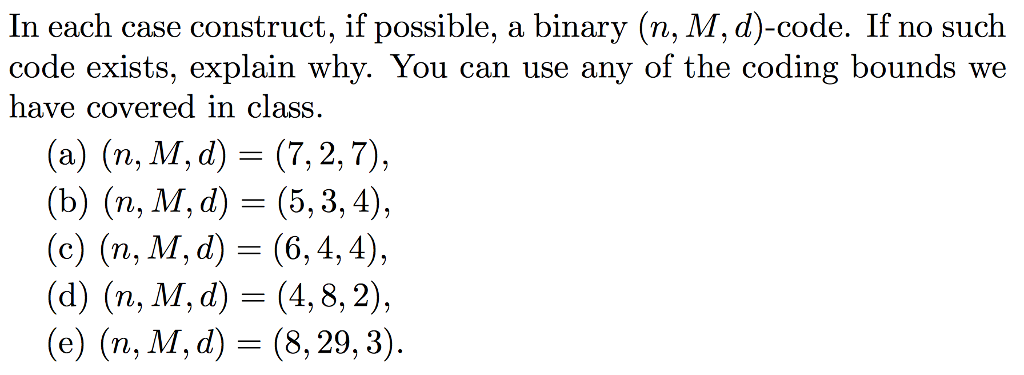
In each case construct, if possible, a binary (n, M, d)-code. If no such code exists, explain why. You can use any of the coding bounds we have covered in class. (a) (n, M, d) = (7, 2, 7), (b) (n, M, d) = (5, 3, 4), (c) (n, M, d) (6,4,4), (d) (n, M, d) = (4,8,2), (e) (n, M, d) = (8, 29, 3)
Step by Step Solution
There are 3 Steps involved in it
1 Expert Approved Answer
Step: 1 Unlock

Question Has Been Solved by an Expert!
Get step-by-step solutions from verified subject matter experts
Step: 2 Unlock
Step: 3 Unlock
 Study Help