







Question: In early 2 0 2 0 , Microsoft made a stunning announcement the world's largest software company pledged to go carbon negative by 2 0
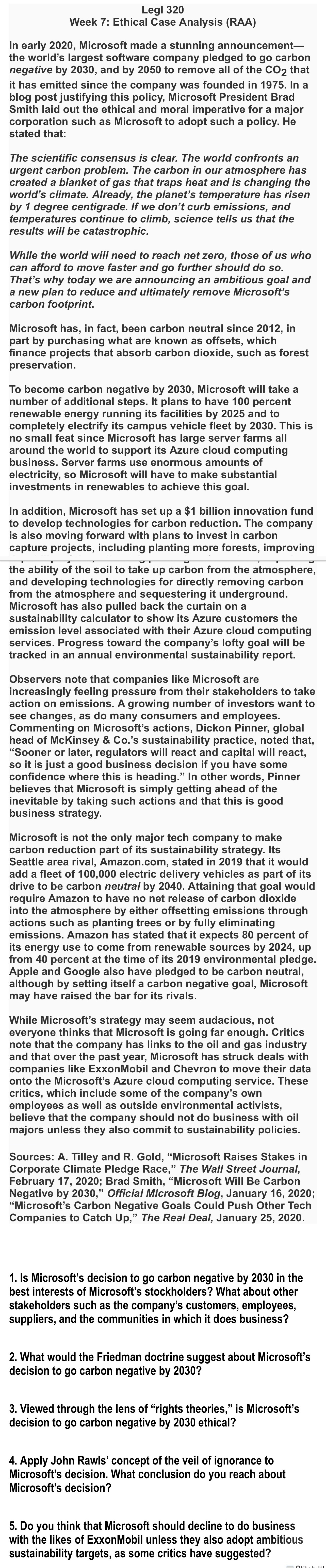
In early Microsoft made a stunning announcement the world's largest software company pledged to go carbon negative by and by to remove all of the CO that it has emitted since the company was founded in In a blog post justifying this policy, Microsoft President Brad Smith laid out the ethical and moral imperative for a major corporation such as Microsoft to adopt such a policy. He stated that:The scientific consensus is clear. The world confronts an urgent carbon problem. The carbon in our atmosphere has created a blanket of gas that traps heat and is changing the world's climate. Already, the planet's temperature has risen by degree centigrade. If we don't curb emissions, and temperatures continue to climb, science tells us that the results will be catastrophic.While the world will need to reach net zero, those of us who can afford to move faster and go further should do soThat's why today we are announcing an ambitious goal and a new plan to reduce and ultimately remove Microsoft's carbon footprint.Microsoft has, in fact, been carbon neutral since in part by purchasing what are known as offsets, which finance projects that absorb carbon dioxide, such as forest preservation.To become carbon negative by Microsoft will take a number of additional steps. It plans to have percent renewable energy running its facilities by and to completely electrify its campus vehicle fleet by This is no small feat since Microsoft has large server farms all around the world to support its Azure cloud computing business. Server farms use enormous amounts of electricity, so Microsoft will have to make substantial investments in renewables to achieve this goal.In addition, Microsoft has set up a $ billion innovation fund to develop technologies for carbon reduction. The company is also moving forward with plans to invest in carbon capture projects, including planting more forests, improving the ability of the soil to take up carbon from the atmosphere, and developing technologies for directly removing carbon from the atmosphere and sequestering it underground.Microsoft has also pulled back the curtain on a sustainability calculator to show its Azure customers the emission level associated with their Azure cloud computing services. Progress toward the company's lofty goal will be tracked in an annual environmental sustainability report.Observers note that companies like Microsoft are increasingly feeling pressure from their stakeholders to take action on emissions. A growing number of investors want to see changes, as do many consumers and employees.Commenting on Microsoft's actions, Dickon Pinner, global head of McKinsey & Cos sustainability practice, noted that,"Sooner or later, regulators will react and capital will react, so it is just a good business decision if you have some confidence where this is heading." In other words, Pinner believes that Microsoft is simply getting ahead of the inevitable by taking such actions and that this is good business strategy.Microsoft is not the only major tech company to make carbon reduction part of its sustainability strategy. Its Seattle area rival, Amazon.com, stated in that it would add a fleet of electric delivery vehicles as part of its drive to be carbon neutral by Attaining that goal would require Amazon to have no net release of carbon dioxide into the atmosphere by either offsetting emissions through actions such as planting trees or by fully eliminating emissions. Amazon has stated that it expects percent of its energy use to come from renewable sources by up from percent at the time of its environmental pledge.Apple and Google also have pledged to be carbon neutral, although by setting itself a carbon negative goal, Microsoft may have raised the bar for its rivals.While Microsoft's strategy may seem audacious, not everyone thinks that Microsoft is going far enough. Critics note that the company has links to the oil and gas industry and that over the past year, Microsoft has struck deals with companies like ExxonMobil and Chevron to move their data onto the Microsoft's Azure cloud computing service. These critics, which include some of the company's own employees as well as outside environmental activists, believe that the company should not do business with oil majors unless they also commit to sustainability policies.Sources: A Tilley and R Gold, "Microsoft Raises Stakes in Corporate Climate Pledge Race," The Wall Street Journal, February ; Brad Smith, "Microsoft Will Be Carbon Negative by Official Microsoft Blog, January ;"Microsoft's Carbon Negative Goals Could Push Other Tech Companies to Catch Up The Real Deal, January Is Microsoft's decision to go carbon negative by in the best interests of Microsoft's stockholders? What about other stakeholders such as the company's customers, employees, suppliers, and the communities in which it does business? What would the Friedman doctrine suggest about Microsoft's decision to go carbon negative by Viewed through the lens of "rights theories," is Microsoft's decision to go carbon negative by ethical? Apply John Rawls' concept of the veil of ignorance to Microsoft's decision. What conclusion do you reach about Microsoft's decision? Do you think that Microsoft should decline to do business with the likes of ExxonMobil unless they also adopt ambitious Sustainability targets, as some critics have suggested?
Step by Step Solution
There are 3 Steps involved in it
1 Expert Approved Answer
Step: 1 Unlock

Question Has Been Solved by an Expert!
Get step-by-step solutions from verified subject matter experts
Step: 2 Unlock
Step: 3 Unlock
 Study Help