







Question: In Example 12.3, assuming that the contractor persisted in using the Gates formula to size the hammer, what hammer energy would be required to drive
In Example 12.3, assuming that the contractor persisted in using the Gates formula to size the hammer, what hammer energy would be required to drive the pile at the given blow count specifications? 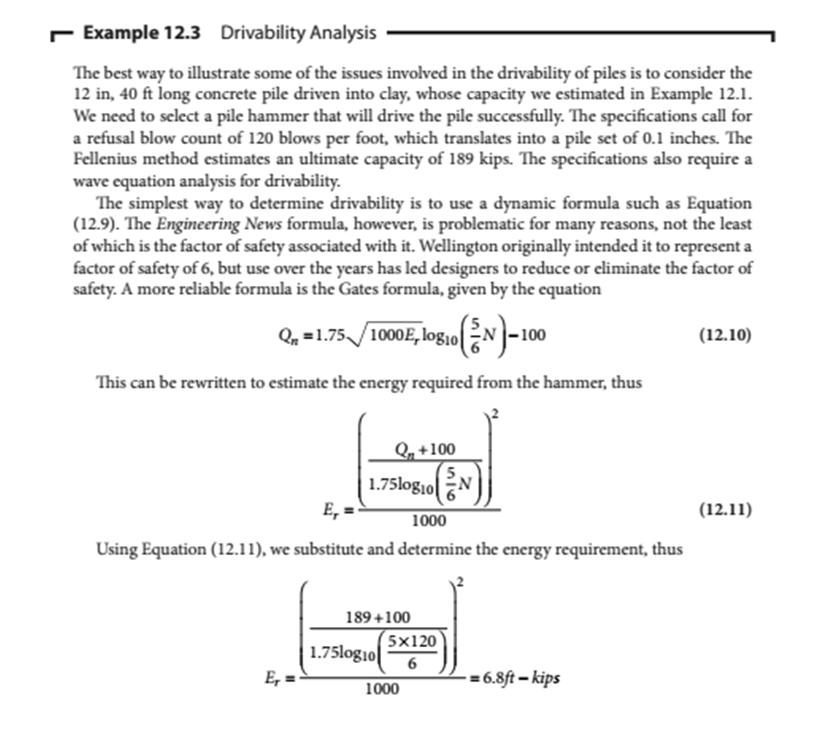
- Example 12.3 Drivability Analysis The best way to illustrate some of the issues involved in the drivability of piles is to consider the 12 in, 40 ft long concrete pile driven into clay, whose capacity we estimated in Example 12.1. We need to select a pile hammer that will drive the pile successfully. The specifications call for a refusal blow count of 120 blows per foot, which translates into a pile set of 0.1 inches. The Fellenius method estimates an ultimate capacity of 189 kips. The specifications also require a wave equation analysis for drivability. The simplest way to determine drivability is to use a dynamic formula such as Equation (12.9). The Engineering News formula, however, is problematic for many reasons, not the least of which is the factor of safety associated with it. Wellington originally intended it to represent a factor of safety of 6, but use over the years has led designers to reduce or eliminate the factor of safety. A more reliable formula is the Gates formula, given by the equation Q =1.75/1000E, log10N]-1 (12.10) This can be rewritten to estimate the energy required from the hammer, thus Q +100 1.75log1oN E, : (12.11) 1000 Using Equation (12.11), we substitute and determine the energy requirement, thus 189+100 5x120 1.75log10 E, = = 6.8ft - kips 1000
Step by Step Solution
3.30 Rating (156 Votes )
There are 3 Steps involved in it
To find the hammer energy required using the Gates formula follow these steps Gi... View full answer

Get step-by-step solutions from verified subject matter experts
 Study Help