







Question: In Figure, blocks ( mathbf { A } ) and ( mathbf { C } ) have the same
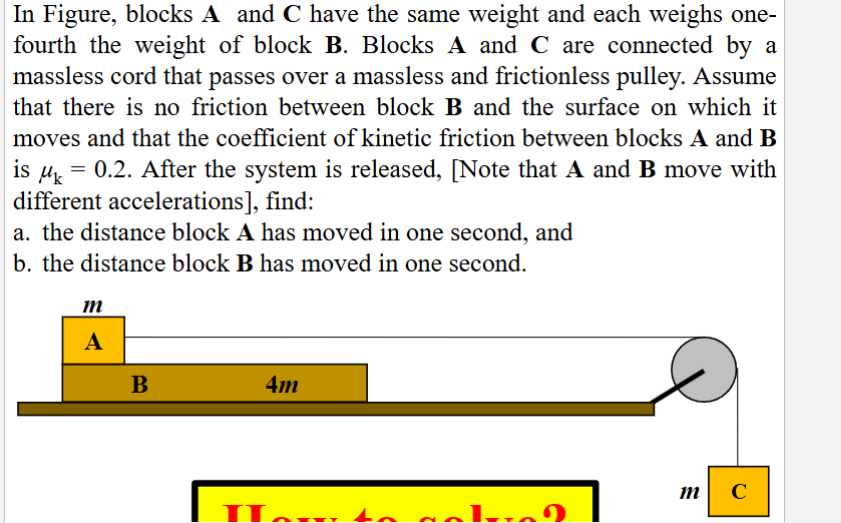
In Figure, blocks mathbfA and mathbfC have the same weight and each weighs onefourth the weight of block mathbfB Blocks mathbfA and mathbfC are connected by a massless cord that passes over a massless and frictionless pulley. Assume that there is no friction between block mathbfB and the surface on which it moves and that the coefficient of kinetic friction between blocks mathbfA and mathbfB is mumathrmk After the system is released, Note that mathbfA and mathbfB move with different accelerations find:
a the distance block mathbfA has moved in one second, and
b the distance block mathbfB has moved in one second.
Step by Step Solution
There are 3 Steps involved in it
1 Expert Approved Answer
Step: 1 Unlock

Question Has Been Solved by an Expert!
Get step-by-step solutions from verified subject matter experts
Step: 2 Unlock
Step: 3 Unlock
 Study Help