







Question: In fortran program potential within a region bounded by conductors. For problems in two dimensions, the Method iteratively calculates the potential using a successive approximation
 In fortran program
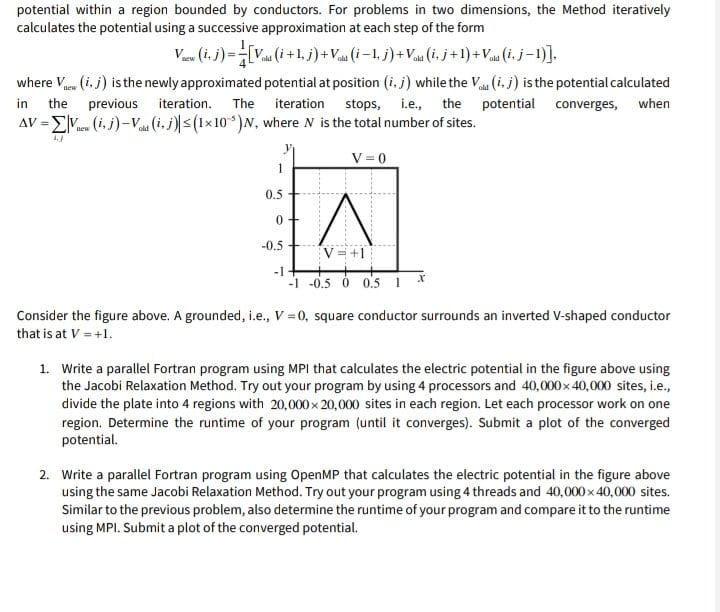
potential within a region bounded by conductors. For problems in two dimensions, the Method iteratively calculates the potential using a successive approximation at each step of the form V.com (1.j)= [ Vou (i +1,j)+ V. (11. j) + Vou (1.j+1) + V. (1.j-1)]. where V (ij) is the newly approximated potential at position (i, j) while the Vol (1,7) is the potential calculated in the previous iteration. The iteration stop, i.e., the potential converges, when AV=(1,3)-V. (1,1)(1x10 )n, where N is the total number of sites. nen 4 V = 0 1 0.5 0 A -0.5 V = +1 - 1 -1 -0.50 0.51 Consider the figure above. A grounded, i.e., V = 0, square conductor surrounds an inverted V-shaped conductor that is at V = +1. 1. Write a parallel Fortran program using MPI that calculates the electric potential in the figure above using the Jacobi Relaxation Method. Try out your program by using 4 processors and 40,000 x 40,000 sites, i.e., divide the plate into 4 regions with 20,000x20,000 sites in each region. Let each processor work on one region. Determine the runtime of your program (until it converges). Submit a plot of the converged potential. 2. Write a parallel Fortran program using OpenMP that calculates the electric potential in the figure above using the same Jacobi Relaxation Method. Try out your program using 4 threads and 40,000x40,000 sites. Similar to the previous problem, also determine the runtime of your program and compare it to the runtime using MPI. Submit a plot of the converged potential
Step by Step Solution
There are 3 Steps involved in it

Get step-by-step solutions from verified subject matter experts
 Study Help