







Question: In healthcare delivery systems, laboratory services play a vital role in inpatient care. Studies have shown that laboratory data affects approximately 65% of the most
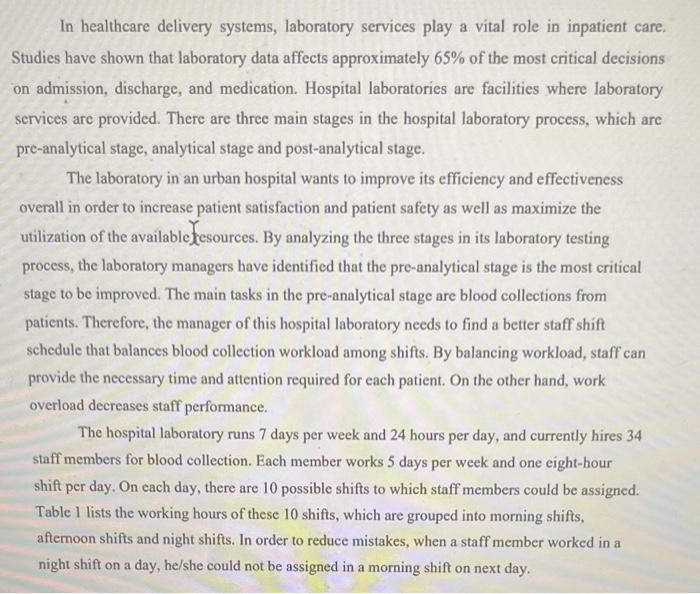
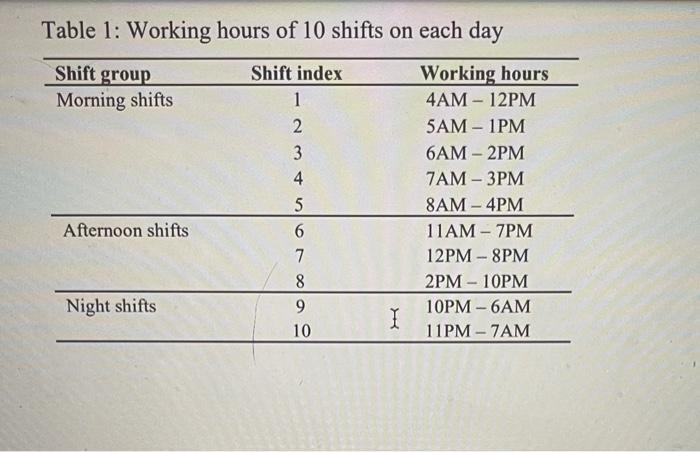
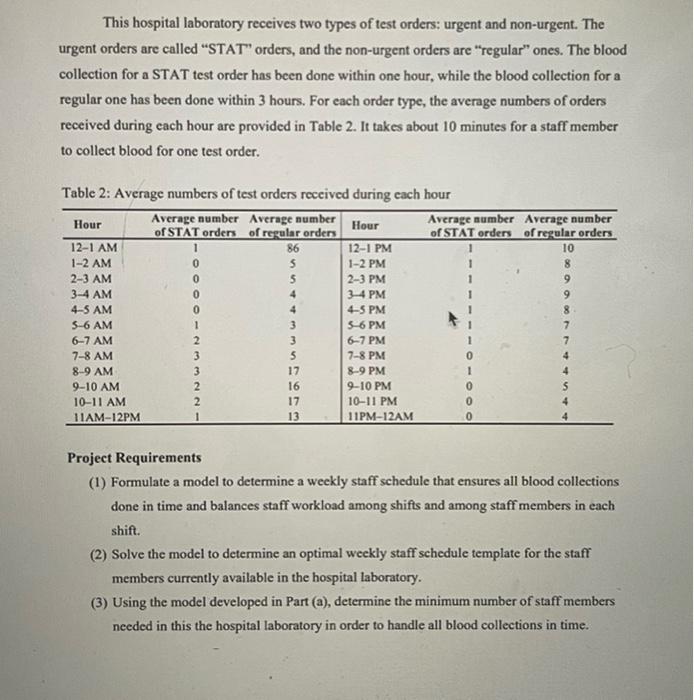
In healthcare delivery systems, laboratory services play a vital role in inpatient care. Studies have shown that laboratory data affects approximately 65% of the most critical decisions on admission, discharge, and medication. Hospital laboratories are facilities where laboratory services are provided. There are three main stages in the hospital laboratory process, which are pre-analytical stage, analytical stage and post-analytical stage. The laboratory in an urban hospital wants to improve its efficiency and effectiveness overall in order to increase patient satisfaction and patient safety as well as maximize the utilization of the available tesources. By analyzing the three stages in its laboratory testing process, the laboratory managers have identified that the pre-analytical stage is the most critical stage to be improved. The main tasks in the pre-analytical stage are blood collections from patients. Therefore, the manager of this hospital laboratory needs to find a better staff shift schedule that balances blood collection workload among shifts. By balancing workload, staff can provide the necessary time and attention required for each patient. On the other hand, work overload decreases staff performance. The hospital laboratory runs 7 days per week and 24 hours per day, and currently hires 34 staff members for blood collection. Each member works 5 days per week and one eight-hour shift per day. On each day, there are 10 possible shifts to which staff members could be assigned. Table 1 lists the working hours of these 10 shifts, which are grouped into morning shifts, afternoon shifts and night shifts. In order to reduce mistakes, when a staff member worked in a night shift on a day, he/she could not be assigned in a morning shift on next day. Shift group Table 1: Working hours of 10 shifts on each day Shift index Working hours Morning shifts 1 4AM - 12PM 2 SAM - 1PM 3 6AM-2PM 4 7AM - 3PM 5 8AM - 4PM Afternoon shifts 6 11AM - 7PM 7 12PM - 8PM 8 2PM - 10PM Night shifts 9 10PM-6AM I 10 11PM - 7AM This hospital laboratory receives two types of test orders: urgent and non-urgent. The urgent orders are called "STAT" orders, and the non-urgent orders are "regular" ones. The blood collection for a STAT test order has been done within one hour, while the blood collection for a regular one has been done within 3 hours. For each order type, the average numbers of orders received during each hour are provided in Table 2. It takes about 10 minutes for a staff member to collect blood for one test order. Table 2: Average numbers of test orders received during each hour Hour Average number Average number Average number Average number Hour of STAT orders of regular orders of STAT orders of regular orders 12-1 AM 1 86 12-1 PM 1 10 1-2 AM 0 5 1-2 PM 1 8 2-3 AM 5 2-3 PM 1 9 3-4 AM 0 4 34 PM 9 4-5 AM 4 4-5 PM 8 5-6 AM 1 3 56 PM 7 6-7 AM 2 3 6-7 PM 7 7-8 AM 3 5 7-8 PM 4 8-9 AM 3 17 8-9 PM 4 9-10 AM 2 16 9-10 PM 0 5 10-11 AM 2 17 10-11 PM 0 4 11AM-12PM 1 13 11PM-12AM 0 4 Project Requirements (1) Formulate a model to determine a weekly staff schedule that ensures all blood collections done in time and balances staff workload among shifts and among staff members in each shift. (2) Solve the model to determine an optimal weekly staff schedule template for the staff members currently available in the hospital laboratory. (3) Using the model developed in Part(a), determine the minimum number of staff members needed in this the hospital laboratory in order to handle all blood collections in time. In healthcare delivery systems, laboratory services play a vital role in inpatient care. Studies have shown that laboratory data affects approximately 65% of the most critical decisions on admission, discharge, and medication. Hospital laboratories are facilities where laboratory services are provided. There are three main stages in the hospital laboratory process, which are pre-analytical stage, analytical stage and post-analytical stage. The laboratory in an urban hospital wants to improve its efficiency and effectiveness overall in order to increase patient satisfaction and patient safety as well as maximize the utilization of the available tesources. By analyzing the three stages in its laboratory testing process, the laboratory managers have identified that the pre-analytical stage is the most critical stage to be improved. The main tasks in the pre-analytical stage are blood collections from patients. Therefore, the manager of this hospital laboratory needs to find a better staff shift schedule that balances blood collection workload among shifts. By balancing workload, staff can provide the necessary time and attention required for each patient. On the other hand, work overload decreases staff performance. The hospital laboratory runs 7 days per week and 24 hours per day, and currently hires 34 staff members for blood collection. Each member works 5 days per week and one eight-hour shift per day. On each day, there are 10 possible shifts to which staff members could be assigned. Table 1 lists the working hours of these 10 shifts, which are grouped into morning shifts, afternoon shifts and night shifts. In order to reduce mistakes, when a staff member worked in a night shift on a day, he/she could not be assigned in a morning shift on next day. Shift group Table 1: Working hours of 10 shifts on each day Shift index Working hours Morning shifts 1 4AM - 12PM 2 SAM - 1PM 3 6AM-2PM 4 7AM - 3PM 5 8AM - 4PM Afternoon shifts 6 11AM - 7PM 7 12PM - 8PM 8 2PM - 10PM Night shifts 9 10PM-6AM I 10 11PM - 7AM This hospital laboratory receives two types of test orders: urgent and non-urgent. The urgent orders are called "STAT" orders, and the non-urgent orders are "regular" ones. The blood collection for a STAT test order has been done within one hour, while the blood collection for a regular one has been done within 3 hours. For each order type, the average numbers of orders received during each hour are provided in Table 2. It takes about 10 minutes for a staff member to collect blood for one test order. Table 2: Average numbers of test orders received during each hour Hour Average number Average number Average number Average number Hour of STAT orders of regular orders of STAT orders of regular orders 12-1 AM 1 86 12-1 PM 1 10 1-2 AM 0 5 1-2 PM 1 8 2-3 AM 5 2-3 PM 1 9 3-4 AM 0 4 34 PM 9 4-5 AM 4 4-5 PM 8 5-6 AM 1 3 56 PM 7 6-7 AM 2 3 6-7 PM 7 7-8 AM 3 5 7-8 PM 4 8-9 AM 3 17 8-9 PM 4 9-10 AM 2 16 9-10 PM 0 5 10-11 AM 2 17 10-11 PM 0 4 11AM-12PM 1 13 11PM-12AM 0 4 Project Requirements (1) Formulate a model to determine a weekly staff schedule that ensures all blood collections done in time and balances staff workload among shifts and among staff members in each shift. (2) Solve the model to determine an optimal weekly staff schedule template for the staff members currently available in the hospital laboratory. (3) Using the model developed in Part(a), determine the minimum number of staff members needed in this the hospital laboratory in order to handle all blood collections in time
Step by Step Solution
There are 3 Steps involved in it

Get step-by-step solutions from verified subject matter experts
 Study Help