







Question: In implementing many OS system calls such as send(), receive(), mutex(), wait(), and signal(), the OS developer has to account for situations in which an
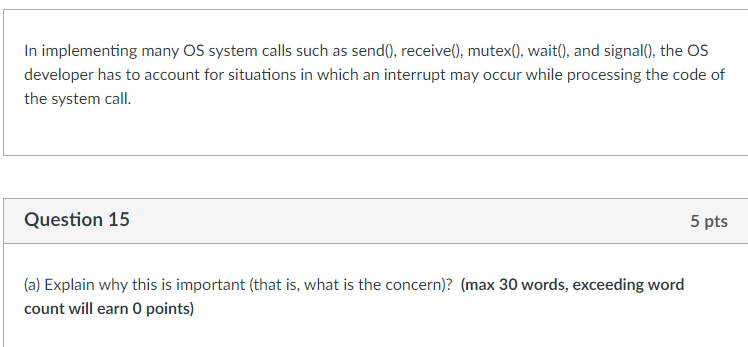

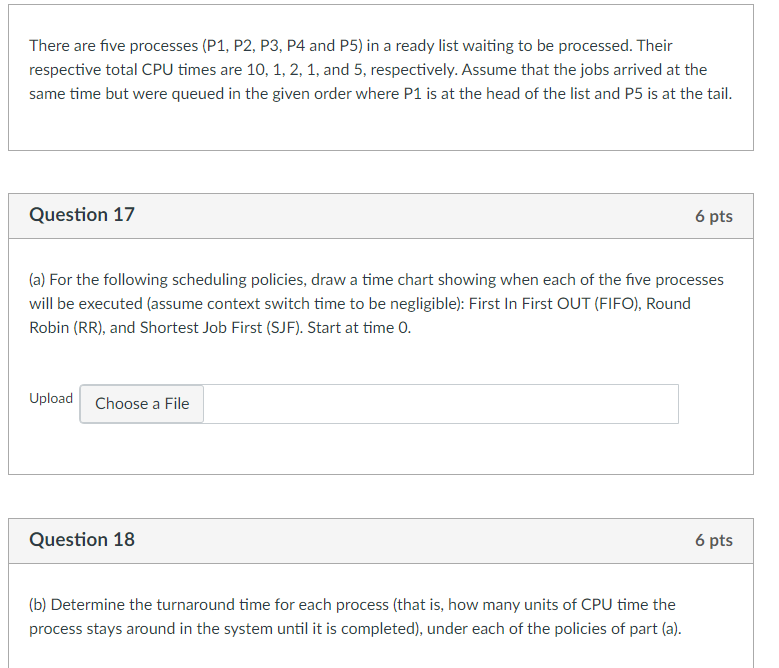

In implementing many OS system calls such as send(), receive(), mutex(), wait(), and signal(), the OS developer has to account for situations in which an interrupt may occur while processing the code of the system call. Question 15 5 pts (a) Explain why this is important (that is, what is the concern)? (max 30 words, exceeding word count will earn 0 points) Question 16 5 pts (b) What can be done to handle nested interrupt properly? (max 20 words, exceeding word count will earn 0 points) There are five processes (P1, P2, P3, P4 and P5) in a ready list waiting to be processed. Their respective total CPU times are 10, 1, 2, 1, and 5, respectively. Assume that the jobs arrived at the same time but were queued in the given order where P1 is at the head of the list and P5 is at the tail. Question 17 6 pts (a) For the following scheduling policies, draw a time chart showing when each of the five processes will be executed (assume context switch time to be negligible): First In First OUT (FIFO), Round Robin (RR), and Shortest Job First (SJF). Start at time 0. Upload Choose a File Question 18 6 pts (b) Determine the turnaround time for each process (that is, how many units of CPU time the process stays around in the system until it is completed), under each of the policies of part (a). Question 19 3 pts (c) Which policy yields the minimum average waiting time (over all processes)
Step by Step Solution
There are 3 Steps involved in it

Get step-by-step solutions from verified subject matter experts
 Study Help