







Question: In java 7. 1/ sorts array of ints into ascending order, smallest to largest // receives: array of ints, list, numElements in list // Example
 In java
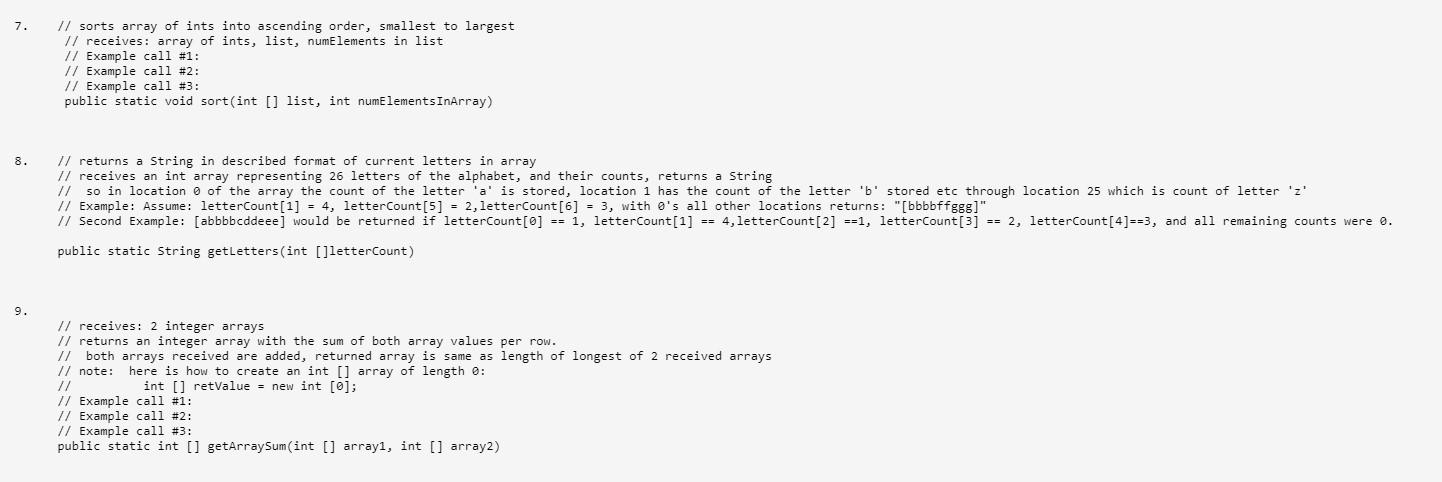
7. 1/ sorts array of ints into ascending order, smallest to largest // receives: array of ints, list, numElements in list // Example call #1: // Example call #2: // Example call #3: public static void sort(int [] list, int numElements InArray) 8. 17 returns a String in described format of current letters in array 1/ receives an int array representing 26 letters of the alphabet, and their counts, returns a String // so in location of the array the count of the letter 'a' is stored, location 1 has the count of the letter 'b' stored etc through location 25 which is count of letter 'z' // Example: Assume: letterCount[1] = 4, letter Count[5] = 2, letterCount [6] = 3, with a's all other locations returns: "[bbbbffggg]" // Second Example: [abbbbcddeee) would be returned if letterCount[0] == 1, letterCount[1] == 4, letterCount[2] ==1, letterCount[3] == 2, letterCount[4]==3, and all remaining counts were e. public static String getLetters(int []letterCount) 9. // receives: 2 integer arrays // returns an integer array with the sum of both array values per row. // both arrays received are added, returned array is same as length of longest of 2 received arrays // note: here is how to create an int [] array of length e: // int () retValue = new int [0]; // Example call #1: 11 Example call #2: // Example call #3: public static int [] getArray Sum(int [] array, int [] array2)
Step by Step Solution
There are 3 Steps involved in it

Get step-by-step solutions from verified subject matter experts
 Study Help