







Question: in Java code A certain city tax is composed of three parts - an income tax, a property tax and a possible tax credit. The
in Java code
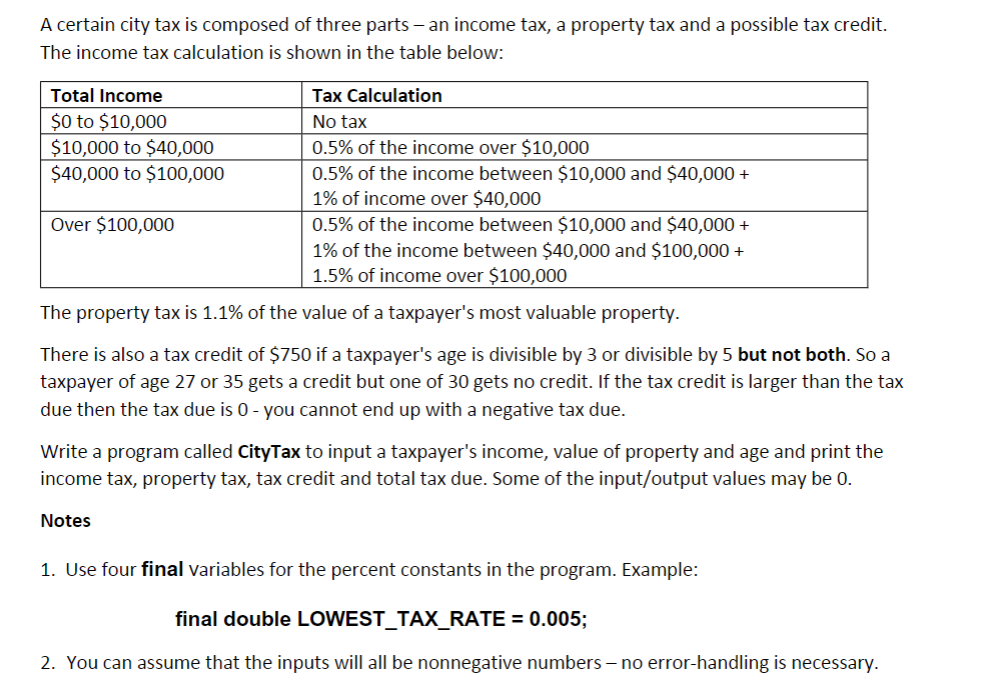
A certain city tax is composed of three parts - an income tax, a property tax and a possible tax credit. The income tax calculation is shown in the table below: The property tax is 1.1% of the value of a taxpayer's most valuable property. There is also a tax credit of $750 if a taxpayer's age is divisible by 3 or divisible by 5 but not both. So a taxpayer of age 27 or 35 gets a credit but one of 30 gets no credit. If the tax credit is larger than the tax due then the tax due is 0 - you cannot end up with a negative tax due. Write a program called CityTax to input a taxpayer's income, value of property and age and print the income tax, property tax, tax credit and total tax due. Some of the input/output values may be 0. Notes 1. Use four final variables for the percent constants in the program. Example: \[ \text { final double LOWEST_TAX_RATE }=\mathbf{0 . 0 0 5} \text {; } \] 2. You can assume that the inputs will all be nonnegative numbers - no error-handling is necessary
Step by Step Solution
There are 3 Steps involved in it

Get step-by-step solutions from verified subject matter experts
 Study Help