







Question: In Java language .. Please I need help in this questions answer as much as you can .. Page I of 6 Question 1: Indicate
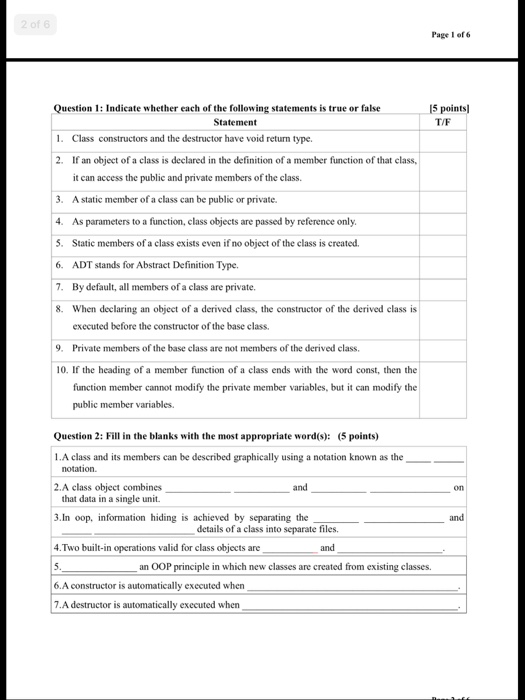
Page I of 6 Question 1: Indicate whether each of the following statements is true or false 1. Class constructors and the destructor have void return type. 2. If an object of a class is declared in the definition of a member function of that class, I5 points] Statement T/F it can access the public and private members of the class. 3. A static member of a class can be public or private. 4. As parameters to a function, class objects are passed by reference only S. Static members of a class exists even if no object of the class is created. 6. ADT stands for Abstract Definition Type. 7. By default, all members of a class are private. 8. When declaring an object of a derived class, the constructor of the derived class is executed before the constructor of the base class. 9. Private members of the base class are not members of the derived class. 10. If the heading of a member function of a class ends with the word const, then the function member cannot modify the private member variables, but it can modify the public member variables. Question 2: Fill in the blanks with the most appropriate word(s): (5 points) 1.A class and its members can be described graphically using a notation known as the notation. 2.A class object combines on that data in a single unit 3.In oop, information hiding is achieved by separating the and details of a class into separate files and 4.Two built-in operations valid for class objects are 5. 6.A constructor is automatically executed when 7.A destructor is automatically executed when an OOP principle in which new classes are created from existing classes
Step by Step Solution
There are 3 Steps involved in it

Get step-by-step solutions from verified subject matter experts
 Study Help