







Question: IN JAVA: ONCE AGAIN, IN JAVA WRITE THIS USING WHAT THEY HAVE GIVEN. public class PA2a { /** * Error to display if input contains
IN JAVA:
ONCE AGAIN, IN JAVA WRITE THIS USING WHAT THEY HAVE GIVEN.
| public class PA2a { | |
| /** | |
| * Error to display if input contains non-numeric characters | |
| */ | |
| public static final String ERR_NON_NUMERIC = "Non-numeric input"; | |
| /** | |
| * Error to display if input is too short | |
| */ | |
| public static final String ERR_SHORT = "Input is too short"; | |
| /** | |
| * Error to display if input is too long | |
| */ | |
| public static final String ERR_LONG = "Input is too long"; | |
| /** | |
| * Error to display if input contains an invalid prefix | |
| */ | |
| public static final String ERR_BAD_PREFIX = "Invalid prefix"; | |
| /** | |
| * Array of valid single-digit prefixes | |
| */ | |
| public static final int[] PREFIXES_ONE_DIGIT = {4, 5, 6}; | |
| /** | |
| * Array of valid double-digit prefixes | |
| */ | |
| public static final int[] PREFIXES_TWO_DIGIT = {37}; | |
| /** | |
| * Minimum input length | |
| */ | |
| public static final int LENGTH_MIN = 13; | |
| /** | |
| * Maximum input length | |
| */ | |
| public static final int LENGTH_MAX = 16; | |
| /** | |
| * Returns true if the supplied argument | |
| * contains only numeric digits (0-9) | |
| * | |
| * @param s input string | |
| * @return true if input contains only numeric digits | |
| */ | |
| public static boolean isOnlyNumbers(String s) { | |
| return false; | |
| } | |
| /** | |
| * Return the numeric value that | |
| * the supplied character represents | |
| * '0' -> 0 | |
| * '1' -> 1 | |
| * ... | |
| * '9' -> 9 | |
| * | |
| * @param c input character (assumed to be a digit) | |
| * @return integer represented by the input | |
| */ | |
| public static int digitCharToInt(char c) { | |
| return 0; | |
| } | |
| /** | |
| * Returns the numeric value that | |
| * the supplied characters represent | |
| * in sequence (c1 is tens place, c2 is ones) | |
| * '00' -> 0 | |
| * '01' -> 1 | |
| * ... | |
| * '10' -> 10 | |
| * '11' -> 11 | |
| * ... | |
| * '90' -> 90 | |
| * '91' -> 91 | |
| * '99' -> 99 | |
| * | |
| * @param c1 tens place digit (assumed to be a digit) | |
| * @param c2 ones place digit (assumed to be a digit) | |
| * @return integer represented by the inputs | |
| */ | |
| public static int digitCharToInt(char c1, char c2) { | |
| // Hint: digitCharToInt could be useful here... | |
| return 0; | |
| } | |
| /** | |
| * Returns true if the supplied integer | |
| * is contained within the array of integers | |
| * | |
| * @param needle item to search for | |
| * @param haystack valid list in which to search | |
| * @return true if needle is in haystack | |
| */ | |
| public static boolean inArray(int needle, int[] haystack) { | |
| return false; | |
| } | |
| /** | |
| * Returns true if the supplied string | |
| * begins with a valid prefix | |
| * | |
| * @param s credit card number (assumed to be comprised only of digits) | |
| * @return true if begins with a valid CC prefix | |
| */ | |
| public static boolean validPrefix(String s) { | |
| // Hint: digitCharToInt and inArray | |
| // could be useful here | |
| return false; | |
| } | |
| /** | |
| * Returns the number of digits | |
| * in an integer | |
| * | |
| * @param num number (assumed to be non-negative) | |
| * @return number of digits in the number | |
| */ | |
| public static int numDigits(int num) { | |
| return 0; | |
| } | |
| /** | |
| * Returns the digit in the specified "place" | |
| * of an input number, where 0 is the ones, | |
| * 1 is the ten's, ... | |
| * | |
| * f(1234, 0) = 4 | |
| * f(1234, 1) = 3 | |
| * f(1234, 2) = 2 | |
| * f(1234, 3) = 1 | |
| * | |
| * @param num input number (assumed to be non-negative) | |
| * @param place place from which to extract the digit (assumed to be [0, #digits-1]) | |
| * @return digit extracted | |
| */ | |
| public static int getDigitInPlace(int num, int place) { | |
| return 0; | |
| } | |
| /** | |
| * Returns a single digit number resulting | |
| * from repeatedly adding the digits of a | |
| * number until it is reduced to a single digit... | |
| * 5678 => 5 + 6 + 7 + 8 = 26 => 2 + 6 = 8 | |
| * | |
| * @param num number (assumed to be non-negative) | |
| * @return single-digit from repeated sums | |
| */ | |
| public static int reduceToDigit(int num) { | |
| // Hint: numDigits and getDigitInPlace | |
| // could be useful here | |
| return 0; | |
| } | |
| /** | |
| * Sums every second digit, right to left. | |
| * If doubling results in a double-digit, | |
| * add up the digits to produce a single. | |
| * 4388576018402626 => | |
| * 2*2 = 4 | |
| * +2*2 = 4 | |
| * +2*4 = 8 | |
| * +2*1 = 2 | |
| * +2*6 = 12 => 3 | |
| * +2*5 = 10 => 1 | |
| * +2*8 = 16 => 7 | |
| * +2*4 = 8 | |
| * = 37 | |
| * | |
| * @param s input string (assumed to be only digits) | |
| * @return sum of doubled evens | |
| */ | |
| public static int sumOfDoubleEvens(String s) { | |
| // Hint: digitCharToInt and reduceToDigit | |
| // could be useful here | |
| return 0; | |
| } | |
| /** | |
| * Sums every odd digit, right to left. | |
| * 4388576018402626 => | |
| * 6+6+0+8+0+7+8+3=38 | |
| * | |
| * @param s input string (assumed to be only digits) | |
| * @return sum of odds | |
| */ | |
| public static int sumOfOdds(String s) { | |
| // Hint: digitCharToInt and reduceToDigit | |
| // could be useful here | |
| return 0; | |
| } | |
| /** | |
| * Returns true if the sum of the | |
| * doubled sum of even digits + | |
| * sum of odd digits is divisible | |
| * by 10. | |
| * | |
| * 4388576018402626: 37 + 38 = 75 % 10 != 0 => false | |
| * 5117275325077359: 18 + 42 = 60 % 10 == 0 => true | |
| * | |
| * @param s input string (assumed to be only digits) | |
| * @return true if passes the Luhn check | |
| */ | |
| public static boolean luhnCheck(String s) { | |
| // Hint: sumOfDoubleEvens and sumOfOdds | |
| // could be useful here | |
| return false; | |
| } | |
| /** | |
| * Inputs a credit card number | |
| * and outputs either input-validation | |
| * error or validation status of the | |
| * card number | |
| * | |
| * @param args command-line arguments, ignored | |
| */ | |
| public static void main(String[] args) { | |
| // Hint: MANY useful methods and constants here | |
| // - isOnlyNumbers() | |
| // - validPrefix() | |
| // - luhnCheck() | |
| // - ERR_ constants | |
| // - LENGTH_ constants | |
| } | |
| } |
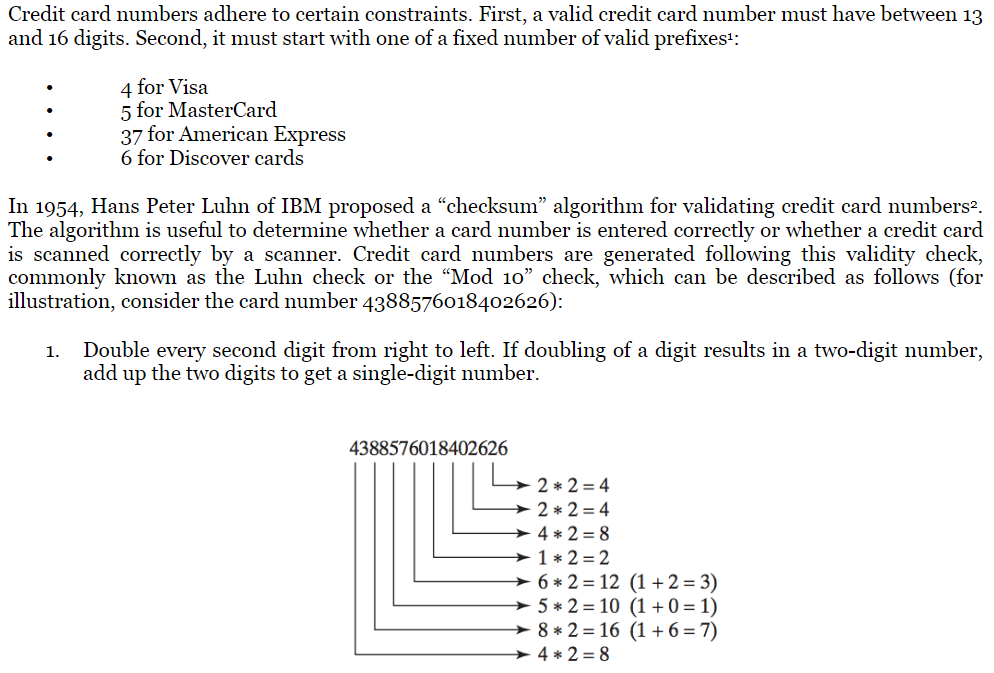
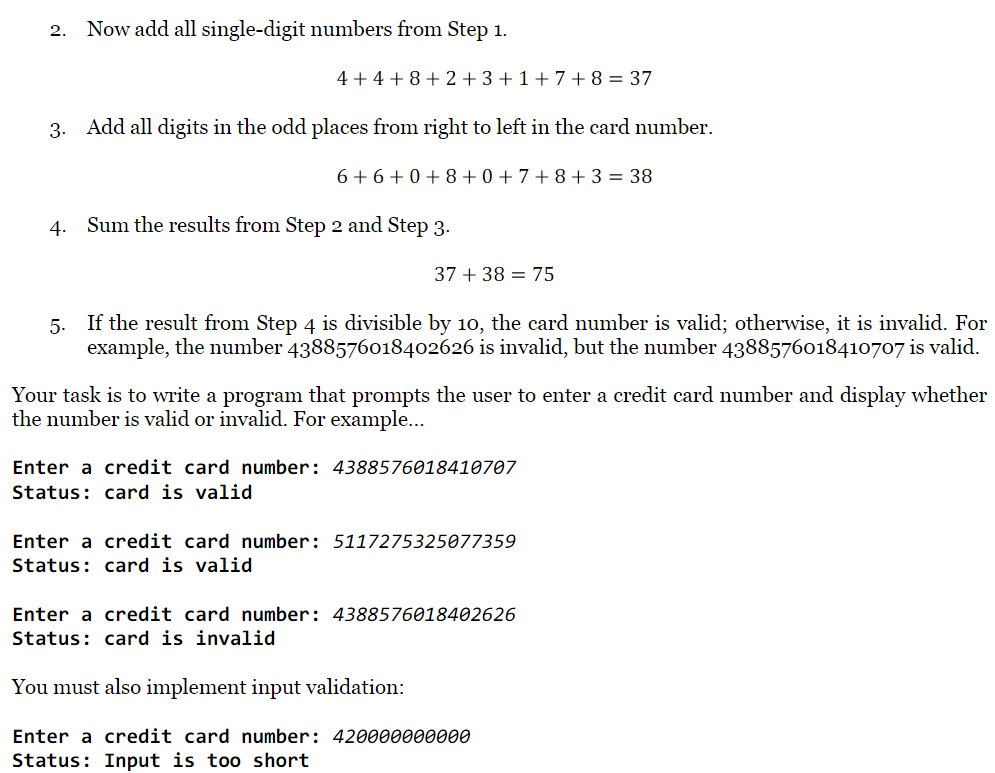
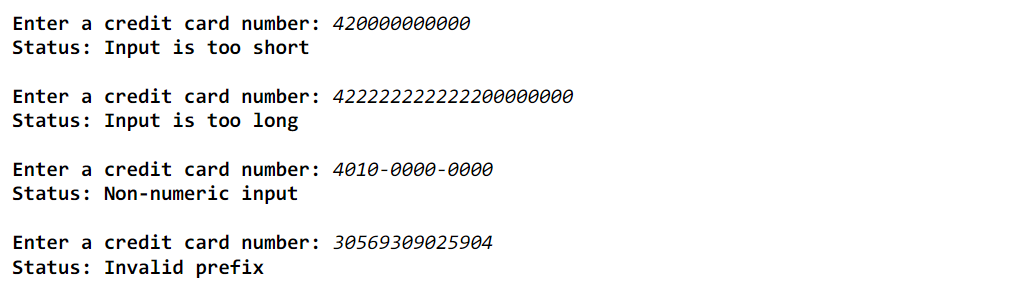
Credit card numbers adhere to certain constraints. First, a valid credit card number must have between 13 and 16 digits. Second, it must start with one of a fixed number of valid prefixes 1 : - 4 for Visa - 5 for MasterCard - 37 for American Express - 6 for Discover cards In 1954, Hans Peter Luhn of IBM proposed a "checksum" algorithm for validating credit card numbers. The algorithm is useful to determine whether a card number is entered correctly or whether a credit card is scanned correctly by a scanner. Credit card numbers are generated following this validity check, commonly known as the Luhn check or the "Mod 10" check, which can be described as follows (for illustration, consider the card number 4388576018402626 ): 1. Double every second digit from right to left. If doubling of a digit results in a two-digit number, add up the two digits to get a single-digit number. 2. Now add all single-digit numbers from Step 1. 4+4+8+2+3+1+7+8=37 3. Add all digits in the odd places from right to left in the card number. 6+6+0+8+0+7+8+3=38 4. Sum the results from Step 2 and Step 3. 37+38=75 5. If the result from Step 4 is divisible by 10 , the card number is valid; otherwise, it is invalid. For example, the number 4388576018402626 is invalid, but the number 4388576018410707 is valid. Your task is to write a program that prompts the user to enter a credit card number and display whether the number is valid or invalid. For example... Enter a credit card number: 4388576018410707 Status: card is valid Enter a credit card number: 5117275325077359 Status: card is valid Enter a credit card number: 4388576018402626 Status: card is invalid You must also implement input validation: Enter a credit card number: 420000000000 Status: Input is too short Enter a credit card number: 420000000000 Status: Input is too short Enter a credit card number: 422222222222200000000 Status: Input is too long Enter a credit card number: 4010-0000-0000 Status: Non-numeric input Enter a credit card number: 30569309025904 Status: Invalid prefix
Step by Step Solution
There are 3 Steps involved in it

Get step-by-step solutions from verified subject matter experts
 Study Help