







Question: in java please and with the code. Suppose you have three nonempty stacks R,S, and T. Describe a sequence of operations that results in S
 in java please and with the code.
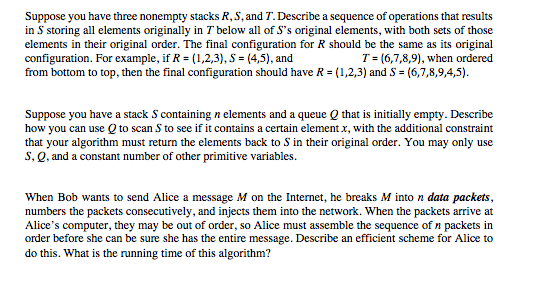
Suppose you have three nonempty stacks R,S, and T. Describe a sequence of operations that results in S storing all elements originally in T below all of S's original elements, with both sets of those elements in their original order. The final configuration for R should be the same as its original configuration. For example, if R-1,2,3),S (4,5), and from bottom to top, then the final configuration should have R (1,2,3) and S (6,7,8,9,4,5). T (6,7,8,9), when ordered Suppose you have a stack S containing n elements and a queue that is initially empty. Describe how you can use Q to scan S to see if it contains a certain element x, with the additional constraint that your algorithm must return the elements back to S in their original order. You may only use S, Q, and a constant number of other primitive variables. When Bob wants to send Alice a message M on the Internet, he breaks M into n data packets numbers the packets consecutively, and injects them into the network. When the packets arrive at Alice's computer, they may be out of order, so Alice must assemble the sequence of n packets in order before she can be sure she has the entire message. Describe an efficient scheme for Alice to do this. What is the running time of this algorithm
Step by Step Solution
There are 3 Steps involved in it

Get step-by-step solutions from verified subject matter experts
 Study Help