







Question: in Java please The findRoot () function in FunctionTest.java works great, but only specifically for the sine function. That's nice and all, but hardly general.
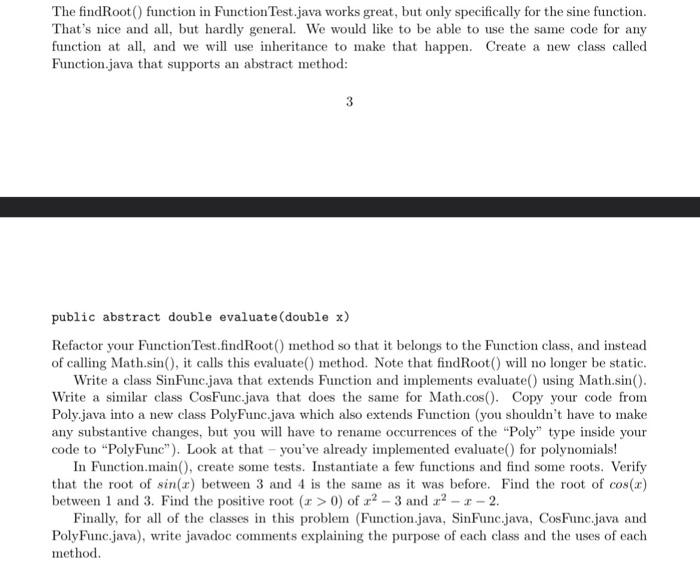
The findRoot () function in FunctionTest.java works great, but only specifically for the sine function. That's nice and all, but hardly general. We would like to be able to use the same code for any function at all, and we will use inheritance to make that happen. Create a new class called Function.java that supports an abstract method: 3 public abstract double evaluate (double x ) Refactor your FunctionTest.findRoot() method so that it belongs to the Function class, and instead of calling Math. sin(), it calls this evaluate() method. Note that findRoot() will no longer be static. Write a class SinFunc.java that extends Function and implements evaluate() using Math.sin(). Write a similar class CosFunc.java that does the same for Math.cos(). Copy your code from Poly.java into a new class PolyFunc.java which also extends Function (you shouldn't have to make any substantive changes, but you will have to rename occurrences of the "Poly" type inside your code to "PolyFunc"). Look at that - you've already implemented evaluate() for polynomials! In Function.main(), create some tests. Instantiate a few functions and find some roots. Verify that the root of sin(x) between 3 and 4 is the same as it was before. Find the root of cos(x) between 1 and 3 . Find the positive root (x>0) of x23 and x2x2. Finally, for all of the classes in this problem (Function.java, SinFunc.java, CosFunc.java and PolyFunc.java), write javadoc comments explaining the purpose of each class and the uses of each method
Step by Step Solution
There are 3 Steps involved in it

Get step-by-step solutions from verified subject matter experts
 Study Help