







Question: In Java, the files listed are included in order below. Also be sure to answer questions at bottom. IncreaseFactorial: package ch04.threads; import ch04.queues.QueueInterface; public class
In Java, the files listed are included in order below. Also be sure to answer questions at bottom.
IncreaseFactorial:
package ch04.threads;
import ch04.queues.QueueInterface;
public class IncreaseFactorial implements Runnable
{
private FactorialCounter c;
private QueueInterface
public IncreaseFactorial(FactorialCounter c, QueueInterface
{
this.c = c; this.q = q;
}
public void run()
{
//String threadName = Thread.currentThread().getName();
//System.out.println("Hello " + threadName);
int hold;
int count;
while (!q.isEmpty())
{
hold = q.dequeue();
//System.out.println("hold = " + hold);
c.multipleIncrement(hold);
}
}
}
FactorialCounter:
package ch04.threads;
public class FactorialCounter {
private float count;
public FactorialCounter()
{
count = 1;
}
public synchronized void increment()
{
count++;
}
public synchronized void multipleIncrement(int times){
//complete this code
}
public synchronized float getCount(){return count;}
}
TestFactorial:
//----------------------------------------------------------------------
// TestFactorial.java by Dale/Joyce/Weems Chapter 3
//
// Repeatedly prompts user for a non-negative integer n.
// Outputs n! calculated recursively and iteratively.
// Uses a command line interface.
//----------------------------------------------------------------------
package ch03.apps;
import ch04.queues.*;
import ch04.threads.*;
import java.util.Scanner;
public class TestFactorial
{
public static float factorialParallel(int n) throws InterruptedException{
float result;
FactorialCounter c1 = new FactorialCounter();
FactorialCounter c2 = new FactorialCounter();
FactorialCounter c3 = new FactorialCounter();
FactorialCounter c4 = new FactorialCounter();
QueueInterface
q = new SyncArrayBoundedQueue
for (int i = 2; i
q.enqueue(i);
//Split up the numbers into 4 intervals
/ must be greater than or equal to 4.
Runnable r1 = new IncreaseFactorial(c1, q);
Runnable r2 = new IncreaseFactorial(c2, q);
Runnable r3 = new IncreaseFactorial(c3, q);
Runnable r4 = new IncreaseFactorial(c4, q);
Thread t1 = new Thread(r1);
Thread t2 = new Thread(r2);
Thread t3 = new Thread(r3);
Thread t4 = new Thread(r4);
t1.start(); t2.start(); t3.start(); t4.start();
t1.join(); t2.join(); t3.join(); t4.join();
//compute result here.
return result;
}
public static float factorialParallelIdea(int n){
float result = 1;
//Thread1
for(int i = n; i > (n - (n/4)); i--)
result *= i;
System.out.println("result for 100 to 76 = " + result);
//Thread2
for(int i = n - (n/4); i > (n - (n/2)); i--)
result *= i;
System.out.println("result for 75 to 51 = " + result);
//Thread3
for(int i = n - (n/2); i > (n - (3*n/4)); i--)
result *= i;
System.out.println("result for 50 to 26 = " + result);
//Thread4
for(int i = n - (3*n/4); i > 0; i--)
result *= i;
System.out.println("result for 25 to 1 = " + result);
return result;
}
public static float factorialParallelRec(int n){
float result = 1;
result = factorial(n) / factorial(3*n/4);
System.out.println("result for 100 to 76 = " + result);
result *= factorial(3*n/4) / factorial(n/2);
System.out.println("result for 75 to 51 = " + result);
result *= factorial(n/2) / factorial(n/4);
System.out.println("result for 50 to 26 = " + result);
result *= factorial(n/4);
System.out.println("result for 25 to 1 = " + result);
return result;
}
private static float factorial(int n)
// Precondition: n is nonnegative
//
// Returns the value of "n!"
{
if (n == 0)
return (float) 1.0;
else
return (n * factorial (n - 1));
}
public static float factorial2(int n)
// Precondition: n is nonnegative
//
// Returns the value of retValue: n!
{
float retValue = 1;
while (n != 0)
{
retValue = retValue * n;
n = n - 1;
}
return(retValue);
}
public static void main(String[] args) throws InterruptedException
{
Scanner scan = new Scanner(System.in);
System.out.println("Factorial calculation test: ");
int n = 0;
long timeStart, timeEnd;
while (n >= 0)
{
System.out.print(" Enter n (-1 to stop) > ");
n = scan.nextInt();
if (n >= 0)
{
System.out.println(n + "! is");
System.out.println("\t recursive " + factorial(n));
System.out.println("\t iterative " + factorial2(n));
timeStart = System.nanoTime();
String s = String.format("%.0f", factorialParallelIdea(n));
timeEnd = System.nanoTime() - timeStart;
System.out.println("\t iterative parallel idea " + s + " total time = " + timeEnd);
timeStart = System.nanoTime();
s = String.format("%.0f", factorialParallel(n));
timeEnd = System.nanoTime() - timeStart;
System.out.println("\t iterative parallel " + s + " total time = " + timeEnd);
System.out.println("\t iterative parallel recursive " + factorialParallelRec(n));
}
}
}
}
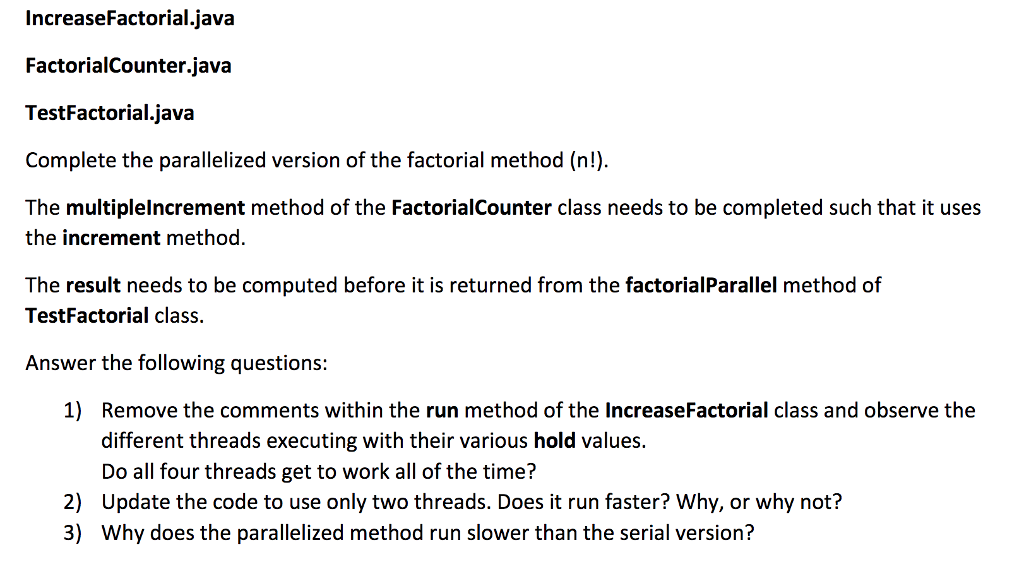
IncreaseFactorial.java FactorialCounter.java TestFactorial.java Complete the parallelized version of the factorial method (n!) The multiplelncrement method of the FactorialCounter class needs to be completed such that it uses the increment method. The result needs to be computed before it is returned from the factorialParallel method of TestFactorial class. Answer the following questions: 1) Remove the comments within the run method of the IncreaseFactorial class and observe the different threads executing with their various hold values. Do all four threads get to work all of the time? Update the code to use only two threads. Does it run faster? Why, or why not? Why does the parallelized method run slower than the serial version? 2) 3) IncreaseFactorial.java FactorialCounter.java TestFactorial.java Complete the parallelized version of the factorial method (n!) The multiplelncrement method of the FactorialCounter class needs to be completed such that it uses the increment method. The result needs to be computed before it is returned from the factorialParallel method of TestFactorial class. Answer the following questions: 1) Remove the comments within the run method of the IncreaseFactorial class and observe the different threads executing with their various hold values. Do all four threads get to work all of the time? Update the code to use only two threads. Does it run faster? Why, or why not? Why does the parallelized method run slower than the serial version? 2) 3)
Step by Step Solution
There are 3 Steps involved in it

Get step-by-step solutions from verified subject matter experts
 Study Help