







Question: In lav some methods my throw an exception when called. Of these methods some must be called from within a try/catch statement for the exception
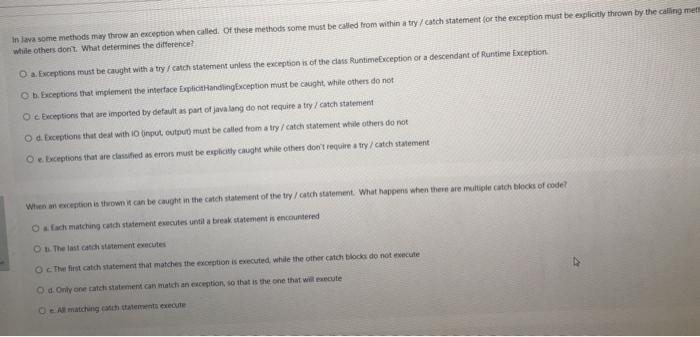
In lav some methods my throw an exception when called. Of these methods some must be called from within a try/catch statement for the exception must be explicitly thrown by the cabing met while others dont What determines the difference? O a Exceptions must be caught with a try / catch statement unless the exception is of the class RuntimeException or a descendant of Runtime Exception on. Exceptions that wiplement the interface ExplicitHandlingException must be caught while others do not OcExceptions that are imported by default as part of javalans do not require a try / catch statement Od Deceptions that deal with to input, output) must be called from a try/catch statement whide others do not Obeceptions that are classified as errons must be explicitly caught while others don't require a try/catch statement When exception in twow it can be caught in the catch statement of the try/cach statement. What happens when there are multiple catch blocks of code? Och matching catch statement executes until a break statement is encountered t. The last cadistatement encules O c The first catch statement that matches the exception is executed while the other catch blocks do not cute Od. Only one catch statement can match an exception, so that is the one that will execute Al matching catch tatements execute
Step by Step Solution
There are 3 Steps involved in it

Get step-by-step solutions from verified subject matter experts
 Study Help