







Question: In ( lcm{5} ) Chapter 2, we talked about how Microsoft had changed its pay strategy to rely less on stock options, more on stock
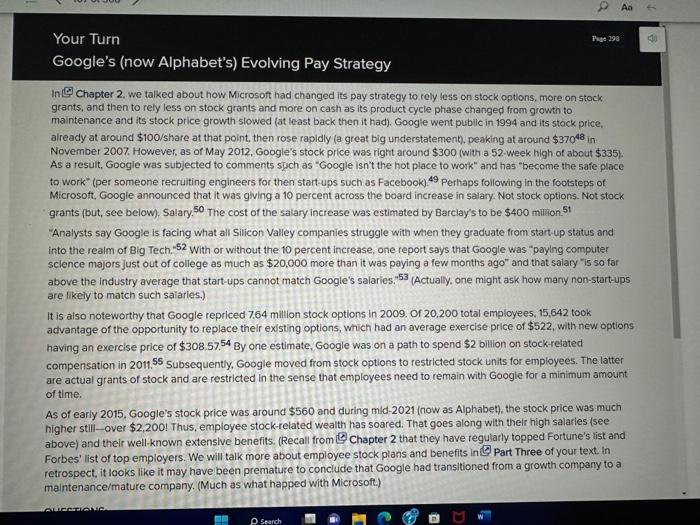
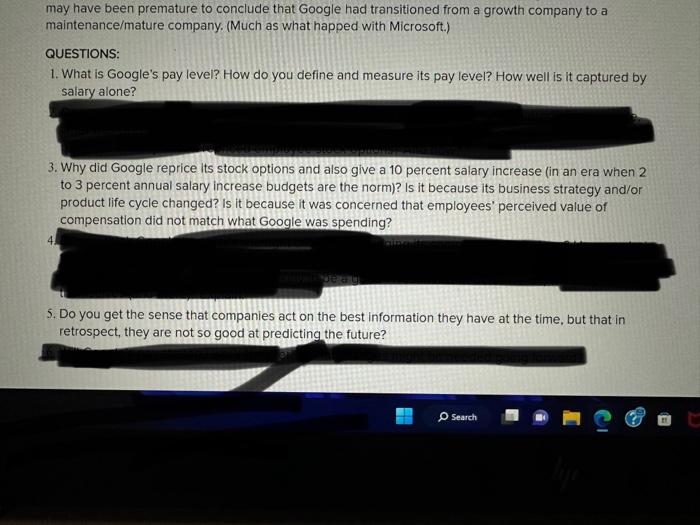
In \( \lcm{5} \) Chapter 2, we talked about how Microsoft had changed its pay strategy to rely less on stock options, more on stock grants, and then to rely less on stock grants and more on cash as its product cycle phase changed from growth to maintenance and its stock price growth slowed (at least back then it had). Google went public in 1994 and its stock price, already at around $100/ share at that point, then rose rapidly (a great big understatement). peaking at around $37048 in November 2007. However, as of May 2012, Google's stock price was right around $300 (with a 52 -week high of about $335 ). As a result, Google was subjected to comments sjuch as "Google isn't the hot place to work" and has "become the safe place to work" (per someone recruiting engineers for then start-ups such as Facebook) 49 Perhaps following in the footsteps of Microsoft, Google announced that it was giving a 10 percent across the board increase in salary. Not stock options. Not stock grants (but, see below). Salary. 50 The cost of the salary increase was estimated by Barclay's to be $400 million. 51 "Analysts say Google is facing what all Silicon Valley companies struggle with when they graduate from start-up status and into the realm of Big Tech. 52 With or without the 10 percent increase, one report says that Google was "paylng computer science majors just out of college as much as $20,000 more than it was paying a few months ago" and that salary "is so far above the industry average that start-ups cannot match Google's salaries." 53 (Actually, one might ask how many non-start-ups are likely to match such saiaries.) It is also noteworthy that Google repriced 7,64 million stock options in 2009 . Of 20,200 total employees, 15,642 took advantage of the opportunity to replace thelr existing options, which had an average exercise price of $522, with new options having an exercise price of $308.5754 By one estimate, Google was on a path to spend $2 billion on stock-related compensation in 2011.55 Subsequently, Google moved from stock options to restricted stock units for employees. The latter are actual grants of stock and are restricted in the sense that employees need to remain with Googie for a minimum amount of time. As of early 2015, Google's stock price was around $560 and during mid-2021 (now as Alphabet), the stock price was much higher still-over $2,200 ! Thus, employee stock-related wealth has soared. That goes along with their high salaries (see above) and their well-known extensive benefits. (Recall from ( Chapter 2 that they have regularly topped Fortune's list and retrospect, it looks like it may have been premature to conclude that Google had transitioned from a growth company to a maintenance/mature company. (Much as what happed with Microsoft.) may have been premature to conclude that Google had transitioned from a growth company to a maintenance/mature company. (Much as what happed with Microsoft.) QUESTIONS: 1. What is Google's pay level? How do you define and measure its pay level? How well is it captured by salary alone? 3. Why did Google reprice its stock options and also give a 10 percent salary increase (in an era when 2 to 3 percent annual salary increase budgets are the norm)? Is it because its business strategy and/or product life cycle changed? Is it because it was concerned that employees' perceived value of compensation did not match what Google was spending? 5. Do you get the sense that companies act on the best information they have at the time, but that in retrospect, they are not so good at predicting the future
Step by Step Solution
There are 3 Steps involved in it

Get step-by-step solutions from verified subject matter experts
 Study Help