







Question: In lecture, we derived Linear Discriminant Analysis ( LDA ) by starting with the Bayes classifier and modeling each class - conditional density as a
In lecture, we derived Linear Discriminant Analysis LDA by starting with the Bayes classifier and modeling
each classconditional density as a multivariate Gaussian and using the same covariance matrix for each. We
stated, but did not prove, that the decision boundary of an LDA classifier is linear.
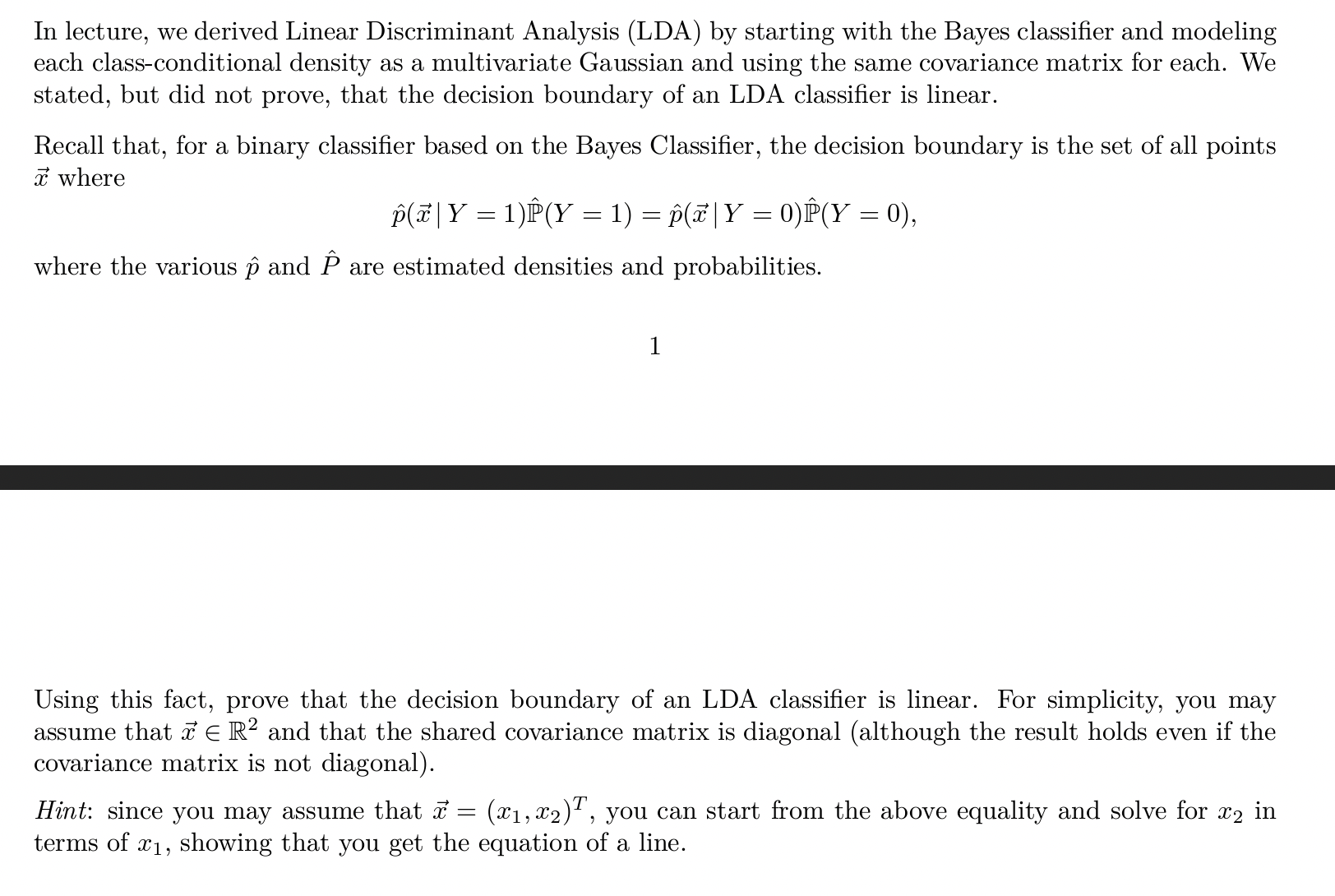
Recall that, for a binary classifier based on the Bayes Classifier, the decision boundary is the set of all points
vec where
hathat
where the various hat and hat are estimated densities and probabilities.
Using this fact, prove that the decision boundary of an LDA classifier is linear. For simplicity, you may
assume that vec and that the shared covariance matrix is diagonal although the result holds even if the
covariance matrix is not diagonal
Hint: since you may assume that vec you can start from the above equality and solve for in
terms of showing that you get the equation of a line.
Step by Step Solution
There are 3 Steps involved in it
1 Expert Approved Answer
Step: 1 Unlock

Question Has Been Solved by an Expert!
Get step-by-step solutions from verified subject matter experts
Step: 2 Unlock
Step: 3 Unlock
 Study Help