







Question: In many applications in CS, we need to convert things (eg, proofs or programs) into a standard or normal form that has the same meaning
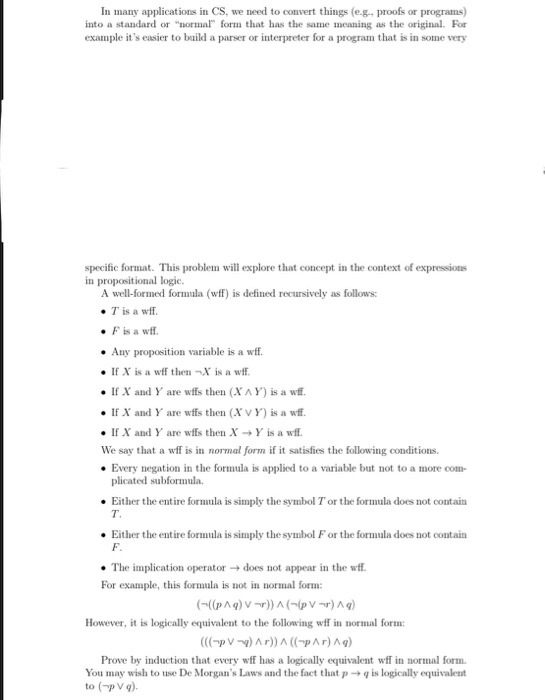
In many applications in CS, we need to convert things (eg, proofs or programs) into a standard or "normal form that has the same meaning as the original. For example it's easier to build a parser or interpreter for a program that is in some very specific format. This problem will explore that concept in the context of expressions in propositional logic. A well-formed formula (wff) is defined recursively as follows: T is a wil . F is a wil Any proposition variable is a wff. . If X is a wff then-X is a wff. If X and Y are wffs then (XAY) is a wif. . If X and Y are wffs then (XVY) is a wif If X and Y are wils then X Y is a wif. We say that a wtf is in normal form if it satisfies the following conditions. Every negation in the formula is applied to a variable but not to a more com plicated subformula . Either the entire formula is simply the symbol T or the formula does not contain T Either the entire formula is simply the symbol For the formula does not contain F. The implication operator does not appear in the wff. For example, this formula is not in normal form: (-p ) V-))^(-(PV )44) However, it is logically equivalent to the following wff in normal form: (PV) Ar)) (par) g) Prove by induction that every wff has a logically equivalent wff in normal form. You may wish to use De Morgan's Laws and the fact that is logically equivalent to (pv)
Step by Step Solution
There are 3 Steps involved in it

Get step-by-step solutions from verified subject matter experts
 Study Help