







Question: in MATLAB please We are interested in evaluating the performance of the following error detection schemes: - Single Parity (SP). - Two Dimensional Parity (TP).
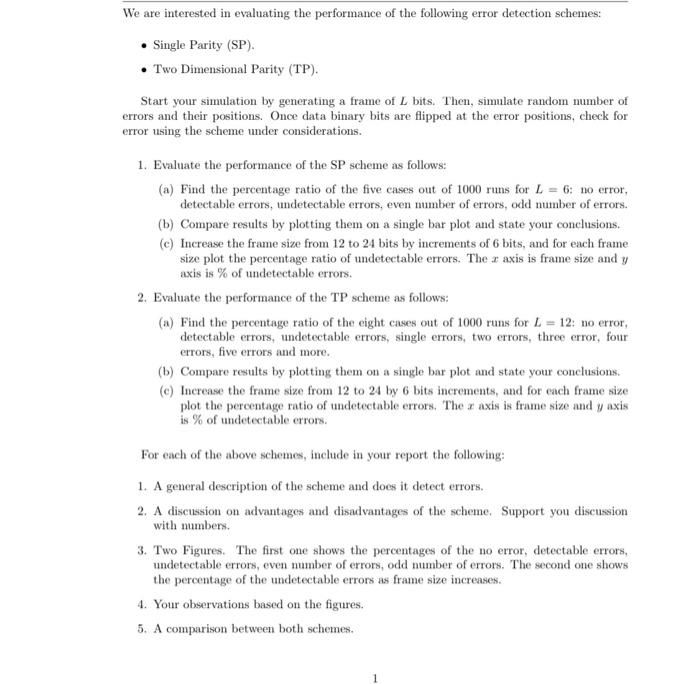
We are interested in evaluating the performance of the following error detection schemes: - Single Parity (SP). - Two Dimensional Parity (TP). Start your simulation by generating a frame of L bits. Then, simulate random number of errors and their positions. Once data binary bits are flipped at the error positions, check for error using the scheme under considerations. 1. Evaluate the performance of the SP scheme as follows: (a) Find the percentage ratio of the five cases out of 1000 runs for L=6 : no error, detectable errors, undetectable errors, even number of errors, odd number of errors. (b) Compare results by plotting them on a single bar plot and state your conclusions. (c) Increase the frame size from 12 to 24 bits by increments of 6 bits, and for each frame size plot the percentage ratio of undetectable errors. The x axis is frame size and y axis is % of undetectable errors. 2. Evaluate the performance of the TP scheme as follows: (a) Find the percentage ratio of the eight cases out of 1000 runs for L=12 : no error, detectable errors, undetectable errors, single errors, two errors, three error, four errors, five errors and more. (b) Compare results by plotting them on a single bar plot and state your conclusions. (c) Increase the frame size from 12 to 24 by 6 bits increments, and for each frame size plot the percentage ratio of undetectable errors. The x axis is frame size and y axis is % of undetectable errors. For each of the above schemes, include in your report the following: 1. A general description of the scheme and does it detect errors. 2. A discussion on advantages and disadvantages of the scheme, Support you discussion with numbers. 3. Two Figures. The first one shows the percentages of the no error, detectable errors, undetectable errors, even number of errors, odd number of errors. The second one shows the percentage of the undetectable errors as frame size increases. 4. Your observations based on the figures. 5. A comparison between both schemes
Step by Step Solution
There are 3 Steps involved in it

Get step-by-step solutions from verified subject matter experts
 Study Help