







Question: In Mips Thanks (b) (10 marks) Write a MIPS assembly language program that computes an approximation for A using the first n terms of the
In Mips Thanks
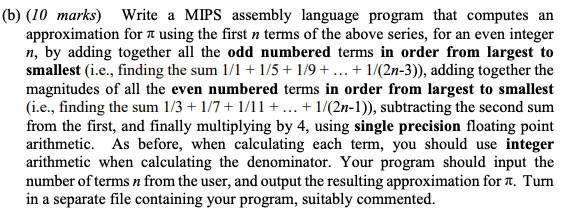
(b) (10 marks) Write a MIPS assembly language program that computes an approximation for A using the first n terms of the above series, for an even integer n, by adding together all the odd numbered terms in order from largest to smallest (i.e., finding the sum 1/1 + 1/5 + 1/9+ ... + 1/(2n-3)), adding together the magnitudes of all the even numbered terms in order from largest to smallest (i.e., finding the sum 1/3+1/7+1/11 + ... + 1/(2n-1)), subtracting the second sum from the first, and finally multiplying by 4, using single precision floating point arithmetic. As before, when calculating each term, you should use integer arithmetic when calculating the denominator. Your program should input the number of terms n from the user, and output the resulting approximation for 7. Turn in a separate file containing your program, suitably commented. (b) (10 marks) Write a MIPS assembly language program that computes an approximation for A using the first n terms of the above series, for an even integer n, by adding together all the odd numbered terms in order from largest to smallest (i.e., finding the sum 1/1 + 1/5 + 1/9+ ... + 1/(2n-3)), adding together the magnitudes of all the even numbered terms in order from largest to smallest (i.e., finding the sum 1/3+1/7+1/11 + ... + 1/(2n-1)), subtracting the second sum from the first, and finally multiplying by 4, using single precision floating point arithmetic. As before, when calculating each term, you should use integer arithmetic when calculating the denominator. Your program should input the number of terms n from the user, and output the resulting approximation for 7. Turn in a separate file containing your program, suitably commented
Step by Step Solution
There are 3 Steps involved in it

Get step-by-step solutions from verified subject matter experts
 Study Help