







Question: In modern networks, including the Internet, the source host segments long, applicationlayer messages (e.g., an image or a music file) into smaller packets and sends
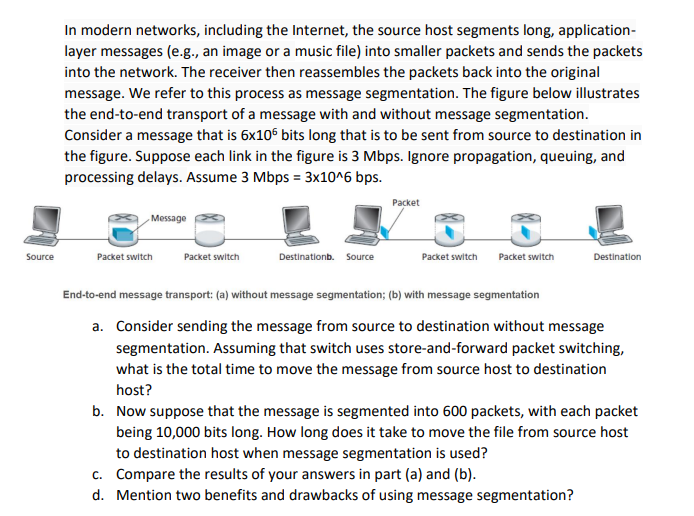
In modern networks, including the Internet, the source host segments long, applicationlayer messages (e.g., an image or a music file) into smaller packets and sends the packets into the network. The receiver then reassembles the packets back into the original message. We refer to this process as message segmentation. The figure below illustrates the end-to-end transport of a message with and without message segmentation. Consider a message that is 6106 bits long that is to be sent from source to destination in the figure. Suppose each link in the figure is 3Mbps. Ignore propagation, queuing, and processing delays. Assume 3Mbps=3106bps. End-to-end message transport: (a) without message segmentation; (b) with message segmentation a. Consider sending the message from source to destination without message segmentation. Assuming that switch uses store-and-forward packet switching, what is the total time to move the message from source host to destination host? b. Now suppose that the message is segmented into 600 packets, with each packet being 10,000 bits long. How long does it take to move the file from source host to destination host when message segmentation is used? c. Compare the results of your answers in part (a) and (b). d. Mention two benefits and drawbacks of using message segmentation
Step by Step Solution
There are 3 Steps involved in it

Get step-by-step solutions from verified subject matter experts
 Study Help