



Question: IN OCAML LANGUAGE - Copy this line to the start of the file: type 'a tree = Leaf I Node of 'a * 'a tree
IN OCAML LANGUAGE
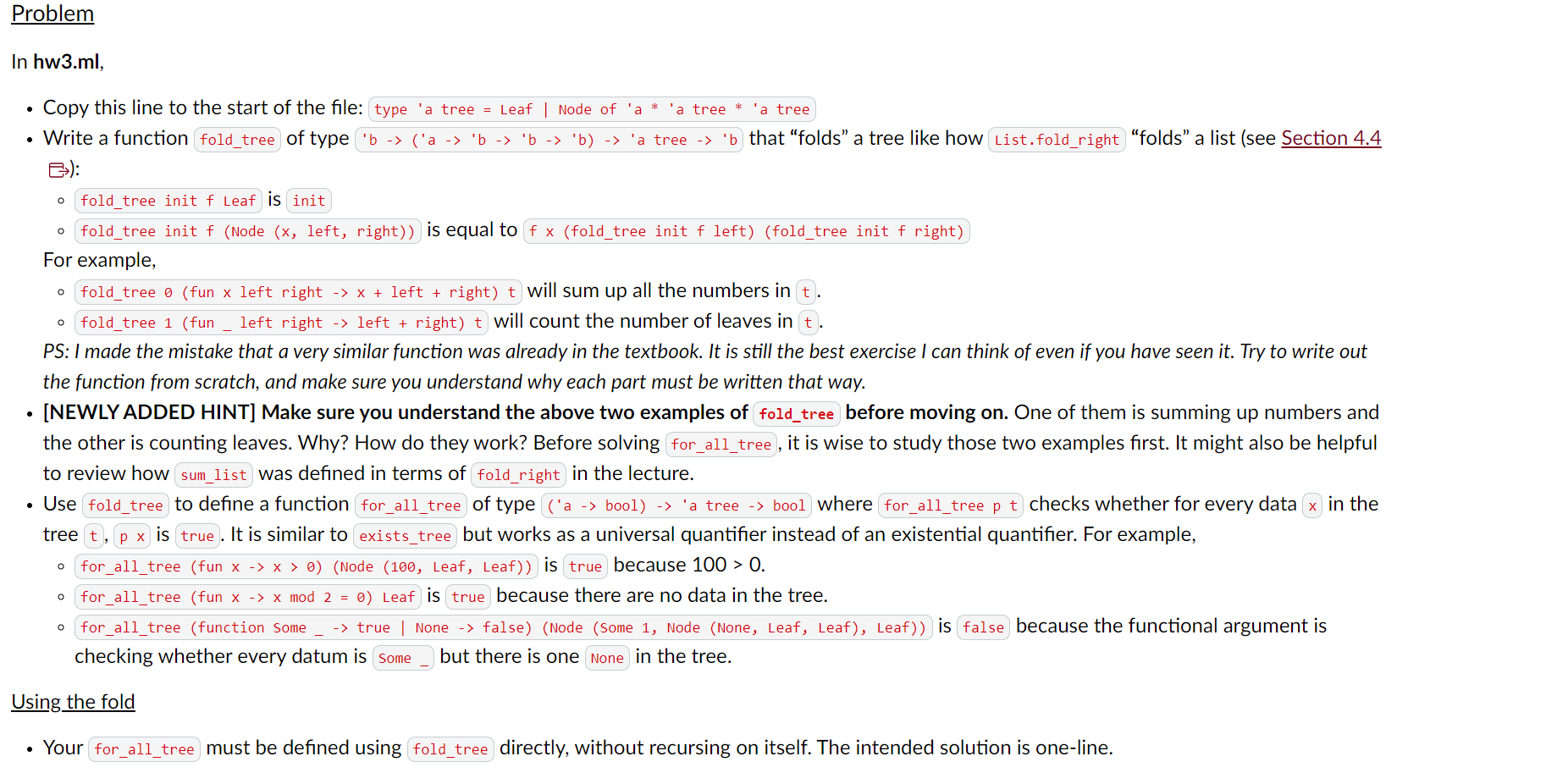
- Copy this line to the start of the file: type 'a tree = Leaf I Node of 'a * 'a tree * 'a tree - Write a function of type b(abb b b) ' tree ' b that "folds" a tree like how "folds" a list (see Section 4.4 G) - fold_tree init f Leaf is init - fold_tree init f (Node (x, left, right)) is equal to For example, - Will sum up all the numbers in - fold_tree 1 (fun _ left right left + right) t will count the number of leaves in PS: I made the mistake that a very similar function was already in the textbook. It is still the best exercise I can think of even if you have seen it. Try to write out the function from scratch, and make sure you understand why each part must be written that way. - [NEWLY ADDED HINT] Make sure you understand the above two examples of before moving on. One of them is summing up numbers and the other is counting leaves. Why? How do they work? Before solving is wise to study those two examples first. It might also be helpful to review how was defined in terms of in the lecture. tree ; true. It is similar to but works as a universal quantifier instead of an existential quantifier. For example, - for_all_tree (fun xx>0 ) (Node (100, Leaf, Leaf)) is because 100>0. - for_all_tree (fun xxmod2=0 ) Leaf is true because there are no data in the tree. - for_all_tree (function some _ true None false) (Node (Some 1, Node (None, Leaf, Leaf), Leaf)) is because the functional argument is checking whether every datum is but there is one in the tree. Using the fold - Your must be defined using directly, without recursing on itself. The intended solution is one-line
Step by Step Solution
There are 3 Steps involved in it

Get step-by-step solutions from verified subject matter experts