







Question: In Ontario Packaging case: Assuming that this proposal is not correct but that make sense to invest in new lamination tools for the future, what
In Ontario Packaging case:
Assuming that this proposal is not correct but that make sense to invest in new lamination tools for the future, what alternative/complement proposal we could do?
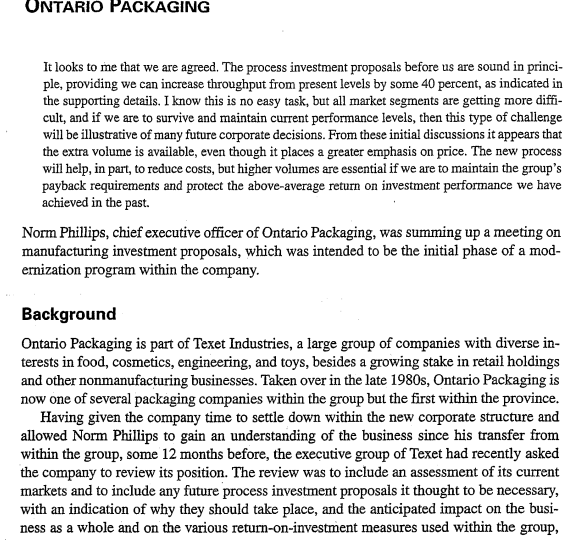
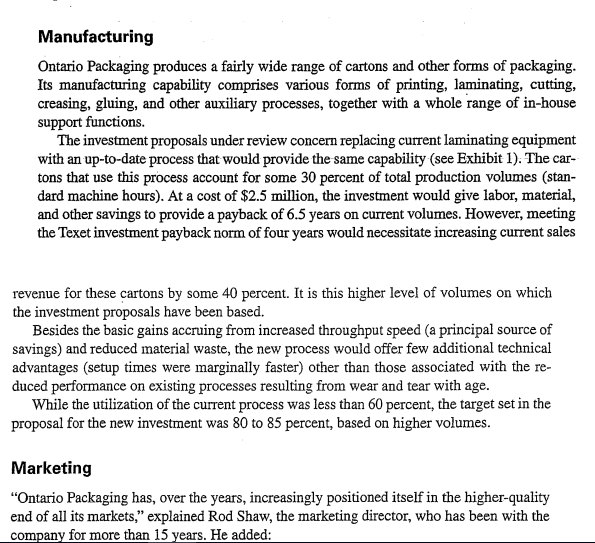
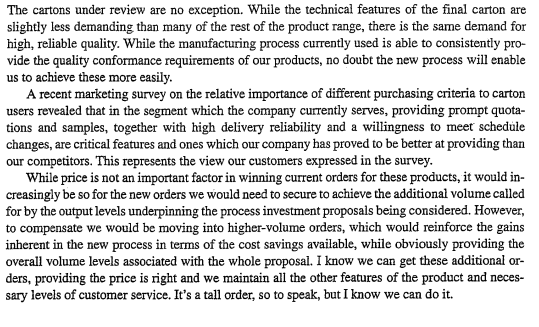
UNTARIO PACKAGING It looks to me that we are agreed. The process investment proposals before us are sound in princi- ple, providing we can increase throughput from present levels by some 40 percent, as indicated in the supporting details. I know this is no easy task, but all market segments are getting more diffi- cult, and if we are to survive and maintain current performance levels, then this type of challenge will be illustrative of many future corporate decisions. From these initial discussions it appears that the extra volume is available, even though it places a greater emphasis on price. The new process will help, in part, to reduce costs, but higher volumes are essential if we are to maintain the group's payback requirements and protect the above-average return on investment performance we have achieved in the past. Norm Phillips, chief executive officer of Ontario Packaging, was summing up a meeting on manufacturing investment proposals, which was intended to be the initial phase of a mod- ernization program within the company. Background Ontario Packaging is part of Texet Industries, a large group of companies with diverse in- terests in food, cosmetics, engineering, and toys, besides a growing stake in retail holdings and other nonmanufacturing businesses. Taken over in the late 1980s, Ontario Packaging is now one of several packaging companies within the group but the first within the province. Having given the company time to settle down within the new corporate structure and allowed Norm Phillips to gain an understanding of the business since his transfer from within the group, some 12 months before, the executive group of Texet had recently asked the company to review its position. The review was to include an assessment of its current markets and to include any future process investment proposals it thought to be necessary, with an indication of why they should take place, and the anticipated impact on the busi- ness as a whole and on the various return-on-investment measures used within the group, Manufacturing Ontario Packaging produces a fairly wide range of cartons and other forms of packaging. Its manufacturing capability comprises various forms of printing, laminating, cutting, creasing, gluing, and other auxiliary processes, together with a whole range of in-house support functions. The investment proposals under review concern replacing current laminating equipment with an up-to-date process that would provide the same capability (see Exhibit 1). The car- tons that use this process account for some 30 percent of total production volumes (stan- dard machine hours). At a cost of $2.5 million, the investment would give labor, material, and other savings to provide a payback of 6.5 years on current volumes. However, meeting the Texet investment payback norm of four years would necessitate increasing current sales revenue for these cartons by some 40 percent. It is this higher level of volumes on which the investment proposals have been based. Besides the basic gains accruing from increased throughput speed (a principal source of savings) and reduced material waste, the new process would offer few additional technical advantages (setup times were marginally faster) other than those associated with the re- duced performance on existing processes resulting from wear and tear with age. While the utilization of the current process was less than 60 percent, the target set in the proposal for the new investment was 80 to 85 percent, based on higher volumes. Marketing "Ontario Packaging has, over the years, increasingly positioned itself in the higher-quality end of all its markets," explained Rod Shaw, the marketing director, who has been with the company for more than 15 years. He added: The cartons under review are no exception. While the technical features of the final carton are slightly less demanding than many of the rest of the product range, there is the same demand for high, reliable quality. While the manufacturing process currently used is able to consistently pro- vide the quality conformance requirements of our products, no doubt the new process will enable us to achieve these more easily. A recent marketing survey on the relative importance of different purchasing criteria to carton users revealed that in the segment which the company currently serves, providing prompt quota- tions and samples, together with high delivery reliability and a willingness to meet schedule changes, are critical features and ones which our company has proved to be better at providing than our competitors. This represents the view our customers expressed in the survey. While price is not an important factor in winning current orders for these products, it would in- creasingly be so for the new orders we would need to secure to achieve the additional volume called for by the output levels underpinning the process investment proposals being considered. However, to compensate we would be moving into higher-volume orders, which would reinforce the gains inherent in the new process in terms of the cost savings available, while obviously providing the overall volume levels associated with the whole proposal. I know we can get these additional or- ders, providing the price is right and we maintain all the other features of the product and neces- sary levels of customer service. It's a tall order, so to speak, but I know we can do it. UNTARIO PACKAGING It looks to me that we are agreed. The process investment proposals before us are sound in princi- ple, providing we can increase throughput from present levels by some 40 percent, as indicated in the supporting details. I know this is no easy task, but all market segments are getting more diffi- cult, and if we are to survive and maintain current performance levels, then this type of challenge will be illustrative of many future corporate decisions. From these initial discussions it appears that the extra volume is available, even though it places a greater emphasis on price. The new process will help, in part, to reduce costs, but higher volumes are essential if we are to maintain the group's payback requirements and protect the above-average return on investment performance we have achieved in the past. Norm Phillips, chief executive officer of Ontario Packaging, was summing up a meeting on manufacturing investment proposals, which was intended to be the initial phase of a mod- ernization program within the company. Background Ontario Packaging is part of Texet Industries, a large group of companies with diverse in- terests in food, cosmetics, engineering, and toys, besides a growing stake in retail holdings and other nonmanufacturing businesses. Taken over in the late 1980s, Ontario Packaging is now one of several packaging companies within the group but the first within the province. Having given the company time to settle down within the new corporate structure and allowed Norm Phillips to gain an understanding of the business since his transfer from within the group, some 12 months before, the executive group of Texet had recently asked the company to review its position. The review was to include an assessment of its current markets and to include any future process investment proposals it thought to be necessary, with an indication of why they should take place, and the anticipated impact on the busi- ness as a whole and on the various return-on-investment measures used within the group, Manufacturing Ontario Packaging produces a fairly wide range of cartons and other forms of packaging. Its manufacturing capability comprises various forms of printing, laminating, cutting, creasing, gluing, and other auxiliary processes, together with a whole range of in-house support functions. The investment proposals under review concern replacing current laminating equipment with an up-to-date process that would provide the same capability (see Exhibit 1). The car- tons that use this process account for some 30 percent of total production volumes (stan- dard machine hours). At a cost of $2.5 million, the investment would give labor, material, and other savings to provide a payback of 6.5 years on current volumes. However, meeting the Texet investment payback norm of four years would necessitate increasing current sales revenue for these cartons by some 40 percent. It is this higher level of volumes on which the investment proposals have been based. Besides the basic gains accruing from increased throughput speed (a principal source of savings) and reduced material waste, the new process would offer few additional technical advantages (setup times were marginally faster) other than those associated with the re- duced performance on existing processes resulting from wear and tear with age. While the utilization of the current process was less than 60 percent, the target set in the proposal for the new investment was 80 to 85 percent, based on higher volumes. Marketing "Ontario Packaging has, over the years, increasingly positioned itself in the higher-quality end of all its markets," explained Rod Shaw, the marketing director, who has been with the company for more than 15 years. He added: The cartons under review are no exception. While the technical features of the final carton are slightly less demanding than many of the rest of the product range, there is the same demand for high, reliable quality. While the manufacturing process currently used is able to consistently pro- vide the quality conformance requirements of our products, no doubt the new process will enable us to achieve these more easily. A recent marketing survey on the relative importance of different purchasing criteria to carton users revealed that in the segment which the company currently serves, providing prompt quota- tions and samples, together with high delivery reliability and a willingness to meet schedule changes, are critical features and ones which our company has proved to be better at providing than our competitors. This represents the view our customers expressed in the survey. While price is not an important factor in winning current orders for these products, it would in- creasingly be so for the new orders we would need to secure to achieve the additional volume called for by the output levels underpinning the process investment proposals being considered. However, to compensate we would be moving into higher-volume orders, which would reinforce the gains inherent in the new process in terms of the cost savings available, while obviously providing the overall volume levels associated with the whole proposal. I know we can get these additional or- ders, providing the price is right and we maintain all the other features of the product and neces- sary levels of customer service. It's a tall order, so to speak, but I know we can do itStep by Step Solution
There are 3 Steps involved in it
1 Expert Approved Answer
Step: 1 Unlock

Question Has Been Solved by an Expert!
Get step-by-step solutions from verified subject matter experts
Step: 2 Unlock
Step: 3 Unlock
 Study Help