







Question: For an unconstrained particle, Lagrange's equations were derived in cylindrical coordinates as d OT T R F.eR = QR, d (27) = M E3
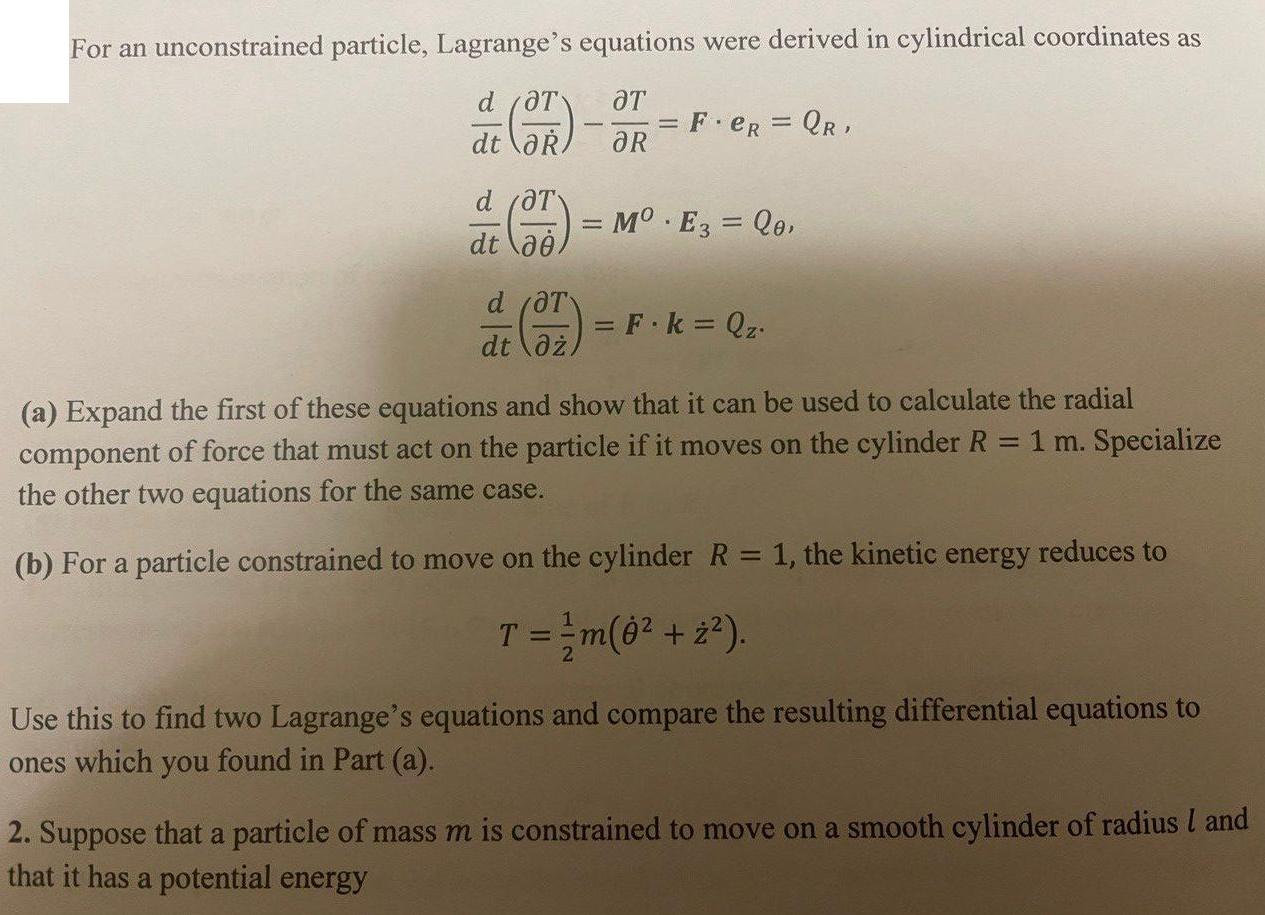
For an unconstrained particle, Lagrange's equations were derived in cylindrical coordinates as d OT T R F.eR = QR, d (27) = M E3 = Q0 dt ao. d OT dt a. = Fk = Qz (a) Expand the first of these equations and show that it can be used to calculate the radial component of force that must act on the particle if it moves on the cylinder R = 1 m. Specialize the other two equations for the same case. (b) For a particle constrained to move on the cylinder R = 1, the kinetic energy reduces to T = m(0 +2). Use this to find two Lagrange's equations and compare the resulting differential equations to ones which you found in Part (a). 2. Suppose that a particle of mass m is constrained to move on a smooth cylinder of radius I and that it has a potential energy
Step by Step Solution
3.41 Rating (151 Votes )
There are 3 Steps involved in it

Get step-by-step solutions from verified subject matter experts
 Study Help